When To Cycle In Madrid: Month By Month
Madrid sits on a high plateau at 667 metres, which gives it cold, crisp winters and serious summer heat. The AEMET climate record for the Retiro station shows exactly which months reward a bike and which ones demand a change of plan.
Short answer
The best months to cycle in Madrid are April, May, June, September and October, when mean temperatures sit between 12.9 and 22.2 °C and rain days stay near three to seven per month. July and August are the hardest, with mean daily maxima of 32.1 °C and 31.3 °C. Tours run year round, from $29.00 per person.
Madrid stands on a high interior plateau, and the official climate record from the Retiro weather station, published by the state meteorological agency AEMET, captures what that means for a cyclist: a mean annual temperature of 15.0 °C, about 59 rain days spread across the year, and roughly 100 clear days. The city is rideable in every month, but the difference between a June morning and an August afternoon is the difference between a pleasant roll past the Prado and a survival exercise.
This guide works through the year using the AEMET normals (the 1981 to 2010 reference series), then matches each season to the guided rides that suit it. The month a reader picks sets which tour slot and which season they book, so the timing decision comes before almost every other one. Everything below pairs Madrid's climate through the year with the tours themselves, at the prices and durations the live booking pages show.
When Is The Best Time Of Year To Cycle In Madrid?
The best window runs from mid-April through June, then September into late October: mean temperatures between 12.9 and 22.2 °C, monthly rainfall at or below 60 mm, and plenty of clear days. July and August, with mean daily maxima of 32.1 °C and 31.3 °C, are the months to ride early or skip midday entirely.
Spring earns its reputation here. April, May and June combine rising temperatures with low rainfall, and June delivers 315 hours of sunshine against just 3.4 rain days. The catch in spring is the wind of change itself: May and June are also the peak months for thunderstorms, 2.9 and 2.8 storm days respectively in the AEMET series, so a clear morning can still turn by late afternoon. Autumn flips the equation. September is close to ideal, and October, though the wettest month at 60 mm, still averages a mean daily maximum of 19.4 °C, which is comfortable riding weather whenever the rain pauses.
Winter deserves more credit than visitors give it. January, the coldest month at a mean of 6.3 °C, still has a mean daily maximum of 9.8 °C and only 5.7 rain days, and December manages 124 hours of sun. Frost is real, 6.2 frost days in January, but Madrid winters are dry and bright far more often than they are grey. A midday winter ride with gloves and a layer is a genuinely good plan, and the tour calendar does not stop for it.
The AEMET normals summarized:
| Month | Mean C | Mean daily max C | Rain mm | Rain days | Clear days | Sun hours |
|---|---|---|---|---|---|---|
| Jan | 6.3 | 9.8 | 33 | 5.7 | 7.8 | 149 |
| Feb | 7.9 | 12.0 | 34 | 5.2 | 6.9 | 158 |
| Mar | 11.2 | 16.3 | 25 | 4.1 | 7.5 | 211 |
| Apr | 12.9 | 18.2 | 45 | 6.7 | 5.4 | 230 |
| May | 16.7 | 22.2 | 50 | 7.3 | 4.6 | 268 |
| Jun | 22.2 | 28.2 | 21 | 3.4 | 9.4 | 315 |
| Jul | 25.6 | 32.1 | 12 | 1.7 | 17.5 | 355 |
| Aug | 25.1 | 31.3 | 10 | 1.7 | 13.6 | 332 |
| Sep | 20.9 | 26.4 | 22 | 3.3 | 8.1 | 259 |
| Oct | 15.1 | 19.4 | 60 | 6.9 | 6.3 | n/a |
| Nov | 9.9 | 13.5 | 58 | 6.5 | 7.1 | 144 |
| Dec | 6.9 | 10.0 | 51 | 6.8 | 6.9 | 124 |
How Does The Month You Pick Change The Ride?
The month sets three things at once: temperature, daylight habits and crowd levels on the classic routes. March through June gives long, mild days around the Centro and Retiro; July and August push sensible riding to the first and last hours; October through February rewards midday starts with quiet plazas. Rain risk peaks in October and November, 60 and 58 mm, and bottoms out in July and August at 12 and 10 mm.
Read down the table above and the shape of the year is obvious. Summer is dry almost to a fault, with 1.7 rain days in each of July and August, while autumn carries the water: October and November sit at 60 and 58 mm apiece, the two wettest months of the year. Winter cold is not the plateau freeze many visitors imagine either. The mean daily minimum in January is 2.7 °C, but the mean daily maximum of 9.8 °C means a 11:00 departure rides in something close to ten degrees, which is a jersey-and-jacket temperature, not an extreme one.
Thunderstorm risk is the spring detail the headline numbers hide. May and June look dry in millimetres, 50 mm and 21 mm, yet they carry the year's highest storm-day counts. A storm in Madrid is usually short and violent, so the practical adjustment in late spring is scheduling: a morning tour slot beats a late-afternoon one, and the free-cancellation terms that most of these rides carry matter more than they do in August.
- City Highlights Rides$29
- Parks And Madrid Río Rides$33.29
- Night And Sunset Rides$40.18
- Day Trips From Madrid$40.18
- E-Bike Tours$41.33
- Private Bike Tours$43.63
Daylight is the other lever, and in Madrid it varies a great deal across the year, from long summer evenings to short winter afternoons. What the AEMET sun-hours column does establish is the shape: 355 hours of sun in July against 124 in December. In practical terms, summer gives a wide window for an evening ride and winter makes the middle of the day the only comfortable one, which suits the sunset-oriented rides in summer and the midday city rides in winter.
Which Rides Suit Which Season?
The general 3-hour city rides work in every month, and prices run from $29.00 to $33.00 for the budget options. The 3-Hour Highlights Bike Ride, 4.9 across 1,989 reviews and from $32.14, is the year-round benchmark. Summer argues for the 1.5-Hour Express Ride from $30.00, and for evening options such as the Sunset and Night Lights E-Bike from $45.00.
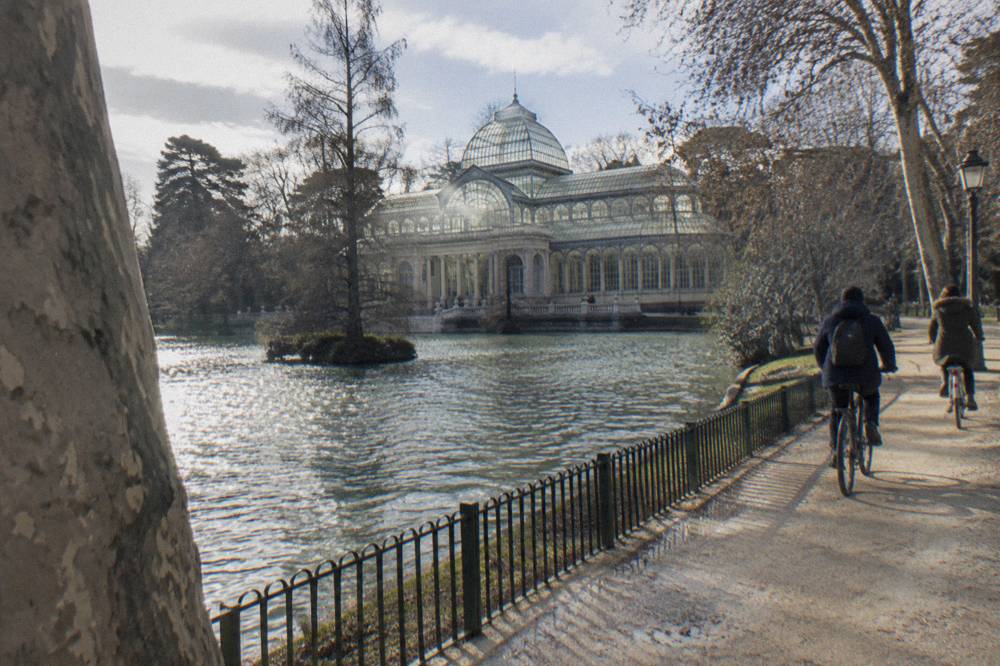
Season matching is mostly a heat-matching exercise. In April, May, September and October any tour on the calendar is fair game, including the five-hour Food E-Bike, All Inclusive (5.0 across 44 reviews, from $102.17, lunch included), which would be punishing in an August afternoon. In deep summer the short and shaded options win: the 1.5-Hour Express Ride keeps exposure brief, and the two-hour sunset rides move the whole experience to the cool end of the day. Winter, finally, is when the longer historical routes, like the Retiro History Ride at two hours and from $33.29, are at their most comfortable, since the cold months reward exactly the kind of slow, story-heavy pacing that overheats in June.
All three start at fixed central addresses, so seasonal transport changes do not matter, though hotel pickup varies by tour: check the booking page.
A season-by-season pairing:
| Season | Best-fit rides | Why |
|---|---|---|
| Spring (Mar to May) | Optional Tapas Highlights Ride, Photo Ride Small Group | Mild means, storm risk argues for morning slots |
| Summer (Jun to Aug) | 1.5-Hour Express Ride, Sunset and Night Lights E-Bike | Short exposure or end-of-day timing beats the heat |
| Autumn (Sep to Nov) | 3-Hour Highlights Bike Ride, Food E-Bike All Inclusive | Warm but fading heat; long tours comfortable again |
| Winter (Dec to Feb) | Vintage Bike Optional Tapas, Retiro History Ride | Midday starts; low prices and quiet plazas |
How Hot Does Summer Cycling In Madrid Get?
July averages a mean of 25.6 °C with a mean daily maximum of 32.1 °C; August averages 25.1 °C with a maximum of 31.3 °C. Those are station means, so individual afternoons run hotter. Rain is nearly absent, 12 mm in July and 10 mm in August. The workable summer pattern is a short morning or evening ride, ideally on an e-bike.
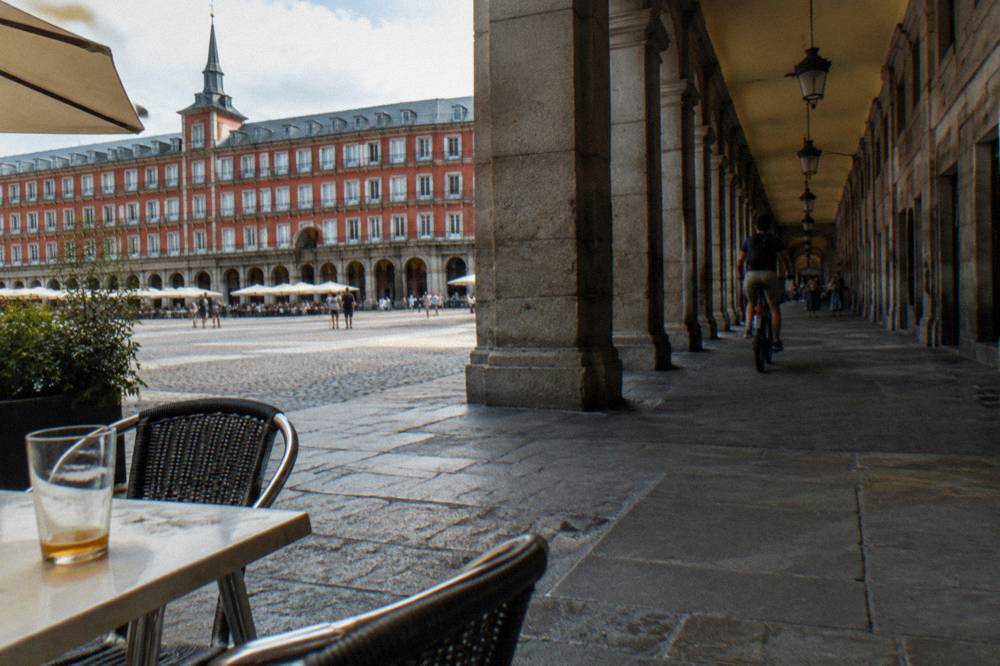
The plateau makes Madrid's heat drier than coastal Spain's, but 355 hours of July sun still fall directly on the asphalt of Gran Vía. Cyclists feel it twice, once from above and once radiating back off the road surface, and effort is the multiplier: a regular bike at touring pace in an August afternoon is a different activity from the same route on an e-bike. That is the honest case for the electric options in summer, and several rides let each rider choose between a regular bike and an e-bike at the same booking, including the 2.5-Hour Bike or E-Bike (4.5 across 815 reviews, from $31.00).
Timing matters more than machinery. The two-hour Sunset and Night Lights E-Bike (4.9 across 17 reviews, from $45.00) exists precisely for this, moving the ride into the hours when the city cools and the lit monuments do the work the daylight did in May. The 1.5-Hour Express Ride (4.8 across 31 reviews, from $30.00) takes the opposite approach: it keeps a classic-center circuit short enough that exposure never builds up. Either beats a three-hour midday booking in August, which is a sentence this guide will not recommend.
Hydration is the third leg of summer planning. Several tours include bottled water in the ticket, among them the 3-Hour Highlights Bike Ride and the 1.5-Hour Express Ride, while others list drinks as not included and expect riders to bring their own; the booking page states which on each ride. Either way, in July and August plan on more water than feels reasonable, and treat the shaded stretches of Retiro as recovery terrain rather than scenery.
Is Winter Cycling In Madrid Worth It?
Yes, for riders who dress for ten degrees. January, the coldest month, averages a mean of 6.3 °C with a mean daily maximum of 9.8 °C and only 5.7 rain days; December and February are similar, and snow is rare, 1.0 snow days in January in the normals. Midday winter slots are comfortable with gloves and a layer, and the classic plazas are at their quietest.
Winter's real cost is daylight and wind chill, not precipitation. The Retiro series records 51 mm of rain in December and 33 to 34 mm in January and February, comparable to spring, and clear-day counts hold at around seven per month, so the odds of a bright, cold, rideable day are genuinely good. What winter does not offer is the evening ride: with the sun-hours column reading 149 in January against 355 in July, the sunset-oriented tours stop making sense and the midday city tours start making a lot of it. Everything else covered here is indexed on Madrid Bike Tours.
The Vintage Bike, Optional Tapas ride suits the winter brief well: three hours at a relaxed pace on a vintage bike, from $29.00 per person, with bottled water included and free cancellation. Its 4.9 rating across 1,151 reviews gives it one of the deepest review pools of any budget option, and an optional tapas finish turns a cold-weather ride into a warm one quickly. For riders who want the winter version of a deep city immersion, the same logic points to the Dutch and English Guided Ride at three hours and from $30.00, a tour with few reviews so far, just 9.
Which Time Of Day Should You Book?
In spring and autumn, any slot from mid-morning to late afternoon works, and the mean daily range spans roughly 7 to 22 °C. In summer, book the earliest and latest slots and skip 13:00 to 17:00 entirely; in winter, book late morning to early afternoon, when the mean daily maximum lands near 10 °C. Sunset and night rides reward summer and shoulder-season bookings most.
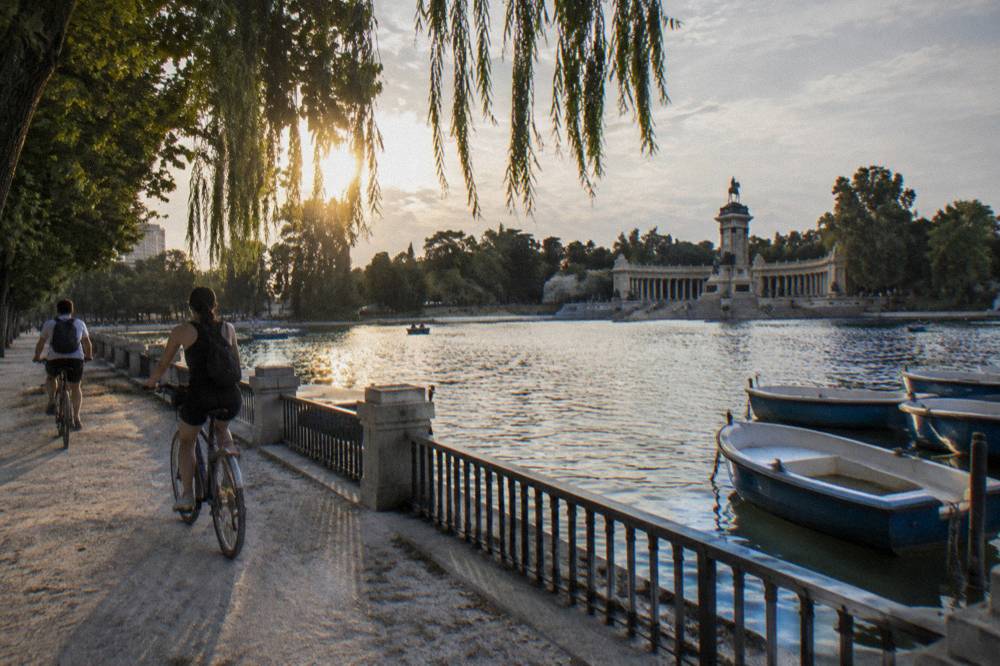
The time-of-day question is really a season question in disguise. May, with a mean minimum of 11.3 °C and a mean maximum of 22.2 °C, barely has a wrong hour; the same ride in August has about four good hours, and in January has about five centered on noon. Riders choosing between a morning and afternoon slot in the shoulder months should weigh crowds as much as temperature, since the classic center around Puerta del Sol and Plaza Mayor is busiest in the middle of the day, and an early start trades two degrees for a lot of empty pavement.
The Sunset and Night Lights E-Bike is the clearest example of a slot-specific product: two hours on an e-bike, from $45.00, rated 4.9 across 17 reviews, designed to run when the day cools and the monuments light up. It is a summer and early-autumn tool. Book it in December and the experience is a night ride in the cold, which is a different proposition; the booking page shows the departure times on offer for the date you choose.
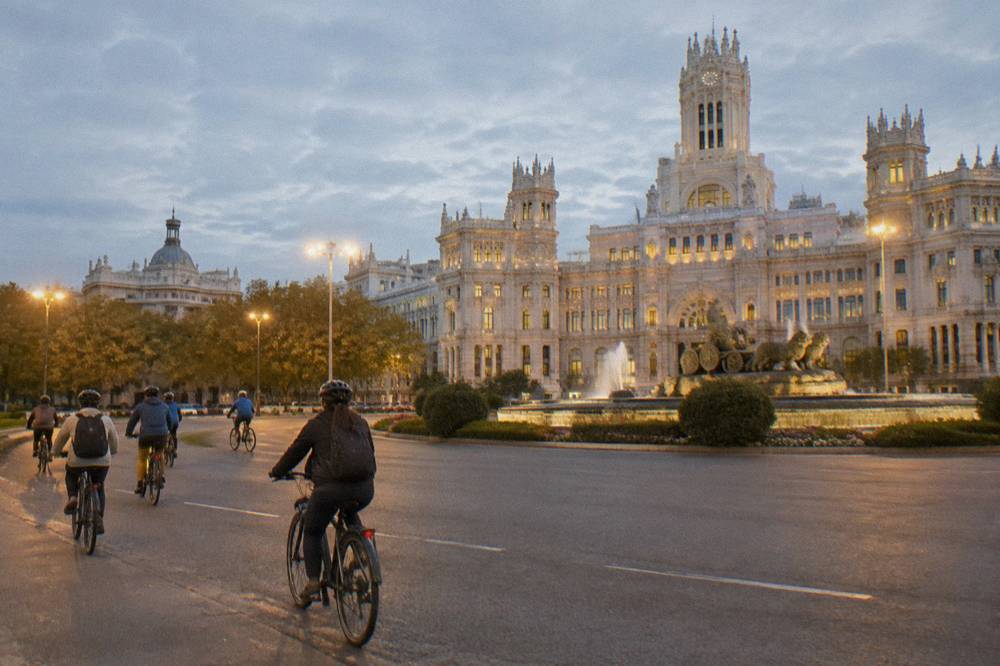
Do Cycling Rules Change With The Season?
The rules stay the same all year, but one recent change matters for day trips: from 1 October 2026, the amended traffic regulation removes the helmet exemptions, so a helmet is required on interurban roads. The road type on the El Escorial and El Pardo routes is not mentioned, and both tours include a helmet. In the city, the Ayuntamiento rule is a helmet for under-18s and a recommendation for adults, in every month.
The city's own cycling FAQ, published by the Ayuntamiento de Madrid, sets the urban baseline: bikes ride on the carriageway, pavements are closed to bikes except signed bike-pavements, side-by-side riding is allowed in one lane where safe, and headphones and phones are out. None of that changes with the weather. What does change seasonally is which rules bite: Casa de Campo's 20 km/h cap applies year round, but the 150-metre visibility requirement for lights matters mainly on dark winter evenings and interurban roads.
The reform angle is the one seasonal trap for autumn and winter bookers. Per the DGT announcement of 23 June 2026, the amended regulation took effect on 1 October 2026, and it also requires drivers overtaking cyclists on interurban roads to slow by at least 20 km/h below the limit. For tours this touches the out-of-town rides, the Segovia E-Bike Day Ride and the El Escorial Nature and History ride in particular, both of which include a helmet in the ticket anyway. City-only rides are unaffected beyond the standing under-18 rule, and the tours that include helmets follow their own tour details, so check what the booking page says for the ride you pick.
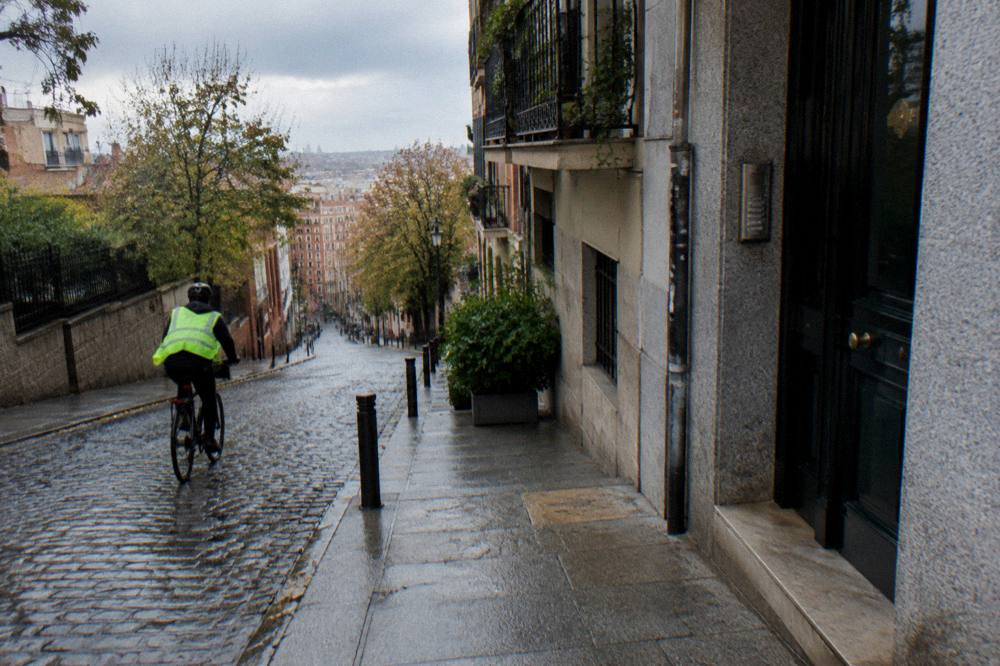
How Should You Plan Around Rain And Crowds?
Plan rain around the October-November peak and the May-June storm season: pick morning slots, keep tours with free cancellation, and hold a museum afternoon as a backup. Crowds peak in summer and around the December lights, when the classic center is busiest; winter weekdays and November offer the quietest riding, with the same tours running from their standard prices.
The free-cancellation detail is worth more than a footnote here. Every Madrid tour covered in this guide states free cancellation on the booking page except one, the Private E-Bike Highlights and Parks ride, which shows weather-dependent cancellation instead; that distinction matters most in exactly the months when a forecast can ruin a plan. In October, a booking you can cancel is a booking you can make in confidence, and in July it costs nothing to reserve a sunset ride and let the temperature decide whether the midday version happens.
Crowds follow the calendar more than the thermometer. The summer months bring the largest visitor volume to the center, and December draws its own wave around the Christmas lights and the Plaza Mayor market season, though specific event dates vary year to year and this page prints none. Against that, a weekday ride in November or January delivers the same monuments, the same guide ratio, and the smallest groups; the trade is simply that a mean of 9.9 °C asks for a jacket. For riders weighing that trade, the pairing advice in the season table above, and the deeper per-park detail in the Retiro park guide, fill in the quiet-route picture.
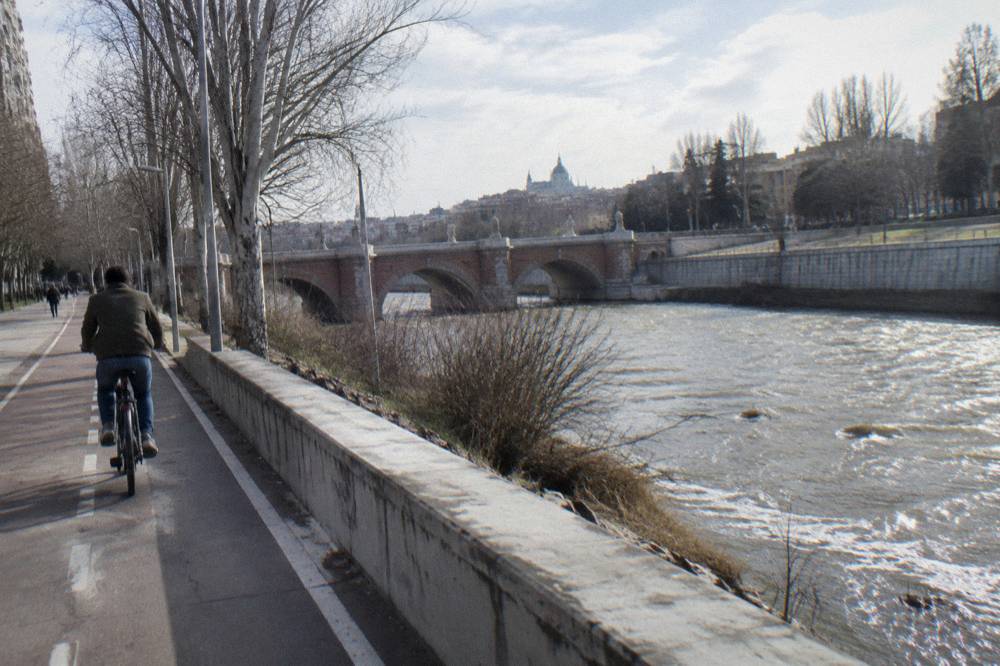
Budget follows season loosely too. The from-prices across the calendar do not move month to month on the booking pages, but availability does: the most reviewed of the 29 tours on this site, the Madrid Highlights Bike Tour with 1,989 reviews, fills first in the shoulder seasons, which is why the booking-ahead question gets its own treatment in when to book a Madrid ride in advance. Riders who want the full heat-versus-effort breakdown before choosing a bike type can also compare the two in e-bike versus regular bike in Madrid.
The Food E-Bike, All Inclusive earns its solo spot as the clearest season-dependent booking on the calendar: five hours, from $102.17, 5.0 across 44 reviews, with lunch included and a group capped at five. In April, May or October it is close to a perfect day out. In August it belongs to the early-morning start or not at all, which is the whole argument of this guide in one tour.
“We had an excellent tour of Madrid and explored fantastic places tasting local food, and drinks ! Our tour guide Kat was very fun and personable:) we enjoyed her and the experience very much ! Highly recommend and be prepared to eat so come with an appetite!”
For riders who want one recommendation that works in every month of the year, the 3-Hour Highlights Bike Ride is the anchor: 4.9 across 1,989 reviews, from $32.14, departing from C. de Felipe IV next to Retiro, with a regular bike or e-bike chosen at booking, a helmet and bottled water included, and a group capped at 15. In August take the earliest slot, in January a later one, and in May whatever hour you like.
The full seasonal picture, for riders comparing at a glance:
| Period | Temp comfort | Rain risk | Crowd level | Best tour style |
|---|---|---|---|---|
| Mar to May | High | Moderate, storms in May | Moderate | Any 3-hour city or tapas ride |
| Jun | High | Low mm, storm days peak | Rising | Morning tours; sunset rides |
| Jul to Aug | Low at midday | Very low | High | Express, e-bike, sunset rides |
| Sep to Oct | High | Peak in Oct | Moderate to high | Long rides, food tour |
| Nov to Feb | Moderate at midday | Moderate | Low | Midday classic rides, vintage tour |
If the month is still open, the short version is this: pick May or September if the trip allows it, June or October a close second, treat July and August as an early-and-late season, and do not fear January, only dress for it. The city, its rules and its tours run all year.
Common Questions About The Best Time To Cycle In Madrid
When Is The Best Time Of Year To Cycle In Madrid?
Mid-April through June and September through late October, when mean temperatures run between 12.9 and 22.2 °C with low rain-day counts. May averages 16.7 °C and September 20.9 °C, both with comfortable mean daily maxima of 22.2 and 26.4 °C.
Is Madrid Too Hot For Cycling In Summer?
Midday in July and August is genuinely hard, with mean daily maxima of 32.1 and 31.3 °C. Early-morning slots, short rides like the 1.5-Hour Express Ride from $30.00, and sunset e-bike tours keep summer rideable.
Can You Cycle In Madrid In Winter?
Yes. January, the coldest month, has a mean of 6.3 °C, a mean daily maximum of 9.8 °C and only 5.7 rain days. A late-morning tour with a jacket and gloves is comfortable, and crowds are at their lowest.
What Is The Rainiest Month For Cycling In Madrid?
October, at 60 mm, followed by November at 58 mm. Even so, October averages 6.9 rain days, so most days stay dry; booking tours with free cancellation covers the rest.
Which Time Of Day Is Best For A Madrid Bike Tour?
In summer, the earliest and latest slots; in winter, late morning to early afternoon. In spring and autumn nearly any hour works, with early starts trading a couple of degrees for emptier plazas.
Do Madrid Bike Tours Run All Year?
Yes, the guided rides covered here run through the calendar, and one operator states plainly that it rides rain or shine. Check the booking page for your date, since departure times shift with the season.