How To Get Around Madrid: Metro, Bus, Taxi And Bike
Madrid's centre is compact, its metro is fast, and its bike-share network is one of the largest in Europe. Here is how the options compare, what each costs, and where a bike tour fits in.
Short answer
The metro is the fastest option for long cross-city trips, with a single ticket and a Tourist Travel Pass from 10.30 EUR for one day in Zone A. For the historic centre, walking and BiciMAD (0.50 EUR for the first 30 minutes) often beat it, and a guided bike tour covers the main sights in about 3 hours from $29 per person.
Madrid is a capital city that behaves, in its centre at least, like a walkable town. The distance from the Royal Palace to Retiro, the two anchors of most sightseeing days, is covered by a 3-hour guided bike ride with stops, which tells you something about how tight the main sights are. Yet the metro carries millions of people a day, the BiciMAD electric bike network runs 8,385 bikes across 683 stations in 21 districts, and taxis remain useful after dark or with luggage. Choosing well among them saves both money and hours. If the BiciMAD option appeals to you, our guide to electric bike rental prices in Madrid lays out what each option costs and what to verify before handing over any money.
This page compares the realistic options for a visitor: metro and bus, the Tourist Travel Pass, BiciMAD bike-share, taxis and rideshares, and guided bike tours. Fares change over time, so confirm the fare in the cab or app, or on a tour's live booking page, before you ride or book. For the sightseeing angle, the 3-Hour Highlights Bike Ride is the reference point: 3 hours, 4.9 across 1,989 reviews, from $32.14 per person, meeting at C. de Felipe IV, 10 by Retiro. Before you commit to any of these options, the breakdown of whether Madrid's guided tours justify their price weighs what a guide actually adds over exploring the city on your own.
What Is The Fastest Way To Get Around Madrid?
For cross-city distances the metro is the fastest option, running every few minutes on twelve lines plus light rail, while buses sit in the same traffic as cars and taxis. For trips inside the historic core, the metro's station spacing often makes walking or a bike quicker door to door, since the centre is dense and largely flat between the Palace and Retiro.
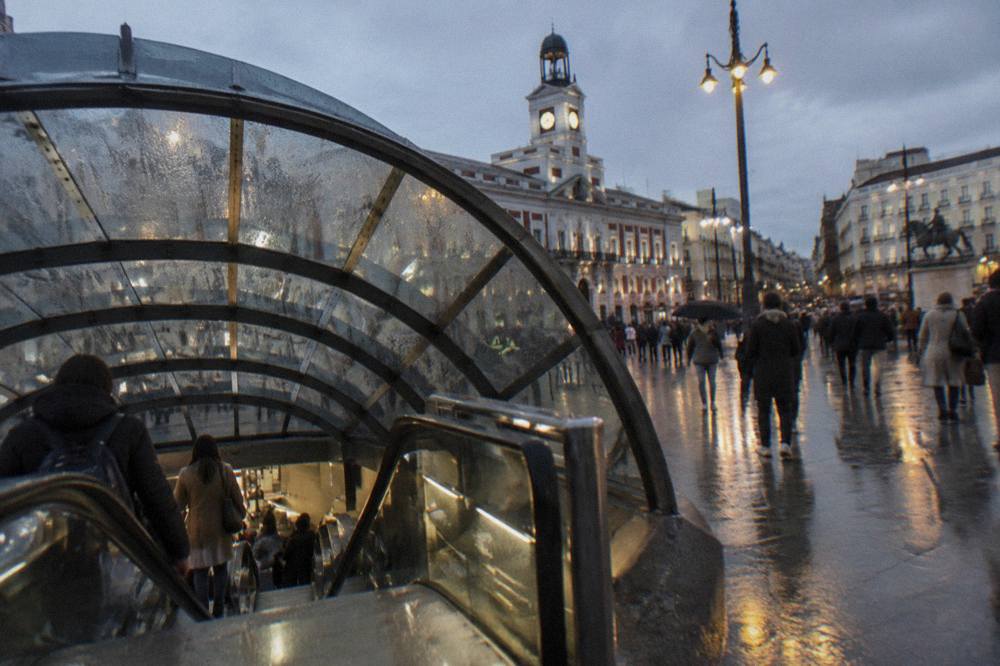
The metro is the workhorse. Trains run frequently through the day and evening, stations are signed in a way that a first-time visitor can follow, and the network reaches every district a tourist is likely to visit, including airport connections. Buses complement it: they are useful for routes the metro does not serve and for seeing the city while moving, but on busy corridors like Gran Vía they move at the pace of the cars around them.
Taxis and rideshares fill the gaps: late nights, luggage days, and trips where a door-to-door run matters more than the fare. They are metered or app-priced, and Madrid's congestion means a cab across the centre at rush hour can be slower than the metro underneath it.
Cycling sits oddly in this ranking, which is why it deserves a proper look further down. For point-to-point transport, BiciMAD's electric bikes beat walking and compete with short metro hops. For sightseeing, a guided bike tour is not really transport at all: it is a way to cover the whole centre, with a guide explaining it, in the time a visitor might otherwise spend finding the right metro exit. The Madrid highlights overview covers that idea in detail.
How Much Does Public Transport In Madrid Cost?
A Tourist Travel Pass for Zone A costs 10.30 EUR for one day, 17.50 EUR for two, 23.10 EUR for three, 27.80 EUR for four, 33.40 EUR for five and 43.20 EUR for seven days, covering metro, bus and Cercanías trains in that zone. It does not include BiciMAD, the city's bike-share system, which is priced separately.
Those pass prices come from the official Madrid tourism site and are the cleanest option for a visitor planning several metro days, since they remove the need to top up a card repeatedly. The multi card itself costs 2.50 EUR and comes free with the tourist card. Zone A covers the city proper; Zone T versions cost more (15.40 EUR for one day up to 62.80 EUR for seven) and add the wider region.
| Pass (Zone A) | Price | What it covers |
|---|---|---|
| 1 day | 10.30 EUR | Metro, EMT buses, Cercanías in Zone A |
| 2 days | 17.50 EUR | Same network |
| 3 days | 23.10 EUR | Same network |
| 5 days | 33.40 EUR | Same network |
| 7 days | 43.20 EUR | Same network |
One warning that catches visitors out: the Tourist Travel Pass does not include BiciMAD. The bike-share system has its own pricing, covered in the next section, and mixing the two up leads to a surprise at the docking station.
Whether the pass pays off depends on usage. A visitor who walks the centre and takes three or four metro trips a day will save money; one who walks everywhere and rides a bike tour will not. Madrid rewards staying on the surface, because the sights cluster: Plaza Mayor, Puerta del Sol, the Royal Palace and the Gran Vía stretch are all within a short walk of each other, and Retiro anchors the other end of the sightseeing zone. Before you set off on foot, the Plaza Mayor history, cafes and best visiting times guide tells you when the square fills up and where to stop for a coffee along the way.
For comparison, a guided bike tour sits outside the transport budget entirely, as an activity: the cheapest option with a substantial review pool is the "Vintage Bike, Optional Tapas" tour at from $29.00 per person, 4.9 across 1,151 reviews, and most standard group rides sit between $30 and $45.
Can You Use BiciMAD Bikes As A Visitor?
Yes. BiciMAD's basic fare costs 0.50 EUR for the first 30 minutes and 0.50 EUR for the second 30, then 3 EUR per further half hour, and a 10 EUR 30-day pass gives unlimited trips up to 30 minutes each. Registration runs through the app, which accepts phone numbers from the EU, UK, Switzerland, Norway, the US, Argentina, Mexico and Brazil.
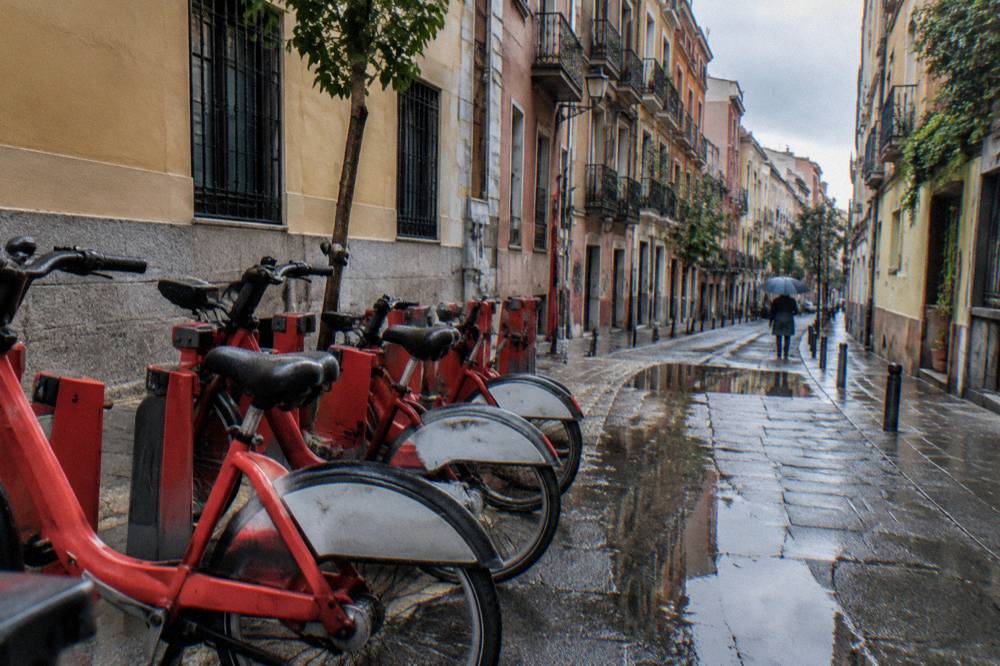
The system is the practical cyclist's answer to Madrid transport. With 8,385 electric bikes across 683 stations in 21 districts, a dock is rarely far away in the central districts, and the electric assist flattens the few climbs, notably the slope up from Madrid Río toward the Palace. The minimum age is 14, with under-18s registered through a parent or guardian, and the helmet is mandatory for riders under 18 and recommended for everyone else.
- City Highlights Rides$29
- Parks And Madrid Río Rides$33.29
- Night And Sunset Rides$40.18
- Day Trips From Madrid$40.18
- E-Bike Tours$41.33
- Private Bike Tours$43.63
The pricing rewards short hops. A 25-minute ride between two sights costs 0.50 EUR, which undercuts almost any other motorized option in the city. The tariff structure penalizes long holds: three hours on one bike becomes expensive, and the system is designed for point-to-point trips, dock to dock, not for a loop with long stops. No day-pass price for tourists is confirmed; some sources mention tourist tickets at station totems, but the current operator pages show only the basic fare and the 30-day pass, so treat any other figure with caution. The official BiciMAD fare page is the source to check before riding.
Two practical limits matter for visitors. Casa de Campo, the large park west of the centre, has no BiciMAD station inside it; the closest dock is at Príncipe Pío, and the park's rules, covered below, cap cycling at 20 km/h on paved roads and wide dirt paths with no cross-country riding. And BiciMAD bikes belong on the road, never the pavement, per the operator's own rules.
Bike-share and guided tours answer different questions. BiciMAD moves a confident cyclist between two points cheaply; a guided tour covers the whole sightseeing core with a route, a guide and the stories attached. A visitor with one full day for sightseeing usually gets more from the tour; a visitor staying a week and running daily errands of sightseeing gets more from the share system.
Is Cycling A Practical Way To Get Around Madrid?
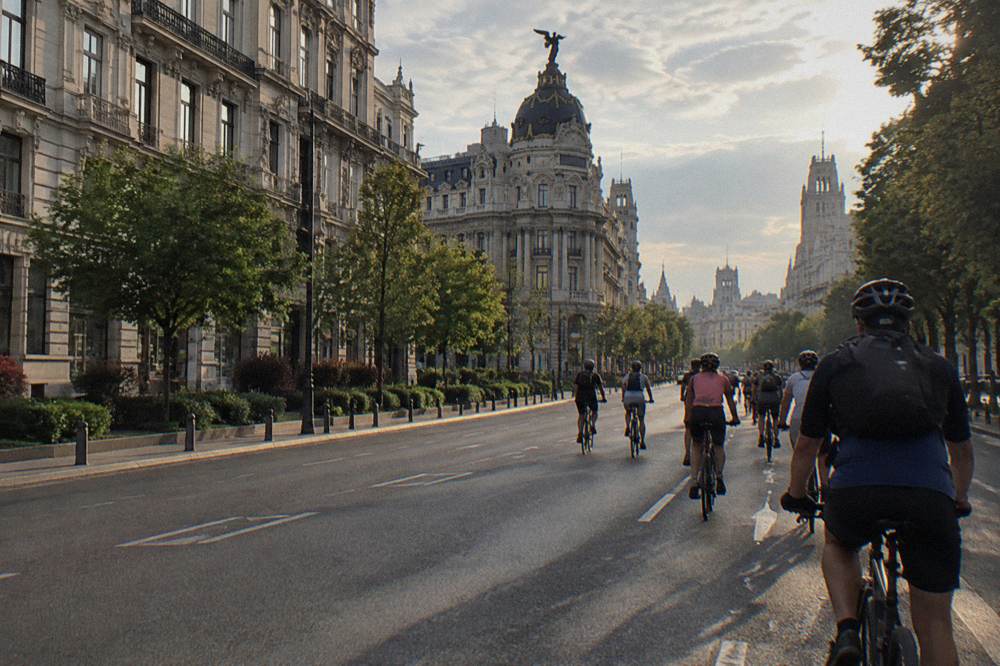
Yes, with qualifications. Madrid's centre is mostly flat or gently sloping, the climate gives about 100 clear days a year, and the city's rules put bikes on the carriageway in the centre of the lane, with bike lanes optional unless a sign makes them mandatory. The July and August heat, with mean maximums above 31 °C, is the main constraint.
The city's own cycling FAQ is unusually direct: bikes ride on the road, in the centre of the lane, and two cyclists may ride side by side in one lane unless it is risky, though never in a reserved bus lane. Pavements and pedestrian streets are closed to bikes except signed bike-pavements capped at 10 km/h. That legal posture, riding in traffic rather than beside it, is what makes cycling in Madrid practical for adults who are comfortable in city traffic and nerve-racking for those who are not. The cycling safety question gets its own treatment elsewhere on this site.
Climatically, the sweet spots are March through June and September through November. July averages a mean maximum of 32.1 °C with just 1.7 rain days; October is the wettest month at 60 mm, then November at 58 mm; January's mean sits at 6.3 °C. Summer riding is possible, but the AEMET climate normals for Madrid Retiro explain why locals shift cycling to early mornings in high summer, a habit the summer heat guide breaks down month by month.
For visitors who want the cycling experience without route-planning or riding in traffic unguided, the guided options divide neatly by format. The "Small-Group E-Bike Gems" tour runs 3 hours 15 minutes in groups capped at 10, from $51.66 per person, rated 4.9 across 189 reviews, meeting at C. de Juan Álvarez Mendizábal, 19. It trades a higher price for a small group and electric assist.
At the other end, the standard group rides, regular bike or e-bike as the rider chooses, cluster around three hours and $30 to $40: the "2.5-Hour Bike or E-Bike" at from $31.00 (4.5 across 815 reviews), the "Optional Tapas Highlights Ride" at from $33.00 (4.9 across 1,633 reviews) and the "3-Hour Highlights Bike Ride" at from $32.14 (4.9 across 1,989 reviews). Total price differences within that band are small; the differences that matter are group size, start point and whether the e-bike option is selected when booking.
How Does A Guided Bike Tour Compare To Exploring Alone?
A guided tour converts three hours into a full loop of the centre with a guide, a bike, a route and stops at Retiro, the Royal Palace area and the old town, from $29 to $56 for standard group rides. Exploring alone is cheaper per day using BiciMAD or a rental, but costs time in navigation, route-finding and working out what you are looking at.
The honest framing is that a bike tour is a sightseeing activity that also happens to solve transport for the morning. Of the 29 tours on this site, the most reviewed is the Rent & Roll Madrid Highlights Bike Tour; its live booking page lists a guide and a bike or e-bike depending on the option chosen, with helmet and water not mentioned, and Royal Palace admission and food not included. It meets at C. de Felipe IV, 10, on the Retiro side of the centre, which makes an easy first-morning anchor before the city fills up. Other pages covering the same trip are gathered on Madrid Bike Tours.
The alternatives slice the same idea differently. The "Optional Tapas Highlights Ride" (from $33.00, 4.9 across 1,633 reviews) adds a tapas stop as an option rather than building it in, and offers an e-bike option. The "Vintage Bike, Optional Tapas" tour (from $29.00, 4.9 across 1,151 reviews) puts riders on vintage bikes in groups that can reach 50, with helmet, bottled water and guide included. A bigger group and a lower price trade against intimacy.
Riders who want parks rather than the historic core have a dedicated line: the "Parks and Riverside Bike Ride" runs 3 hours 15 minutes in groups capped at 10, regular bike or e-bike, from $40.18 per person, rated 4.8 across 29 reviews. And for a full-day splurge, the "5-Hour Food E-Bike, All Inclusive" covers the city with lunch built in, groups capped at 5, from $102.17 per person, rated 5.0 across 44 reviews; it is the only tour on the books where a meal is part of the ticket rather than an add-on.
Going alone changes the calculus. BiciMAD pricing works out cheaper than any tour for pure movement, but the rider carries the route-finding, the lock discipline and the traffic judgment. A middle path many visitors take: one guided ride on day one to learn the geography, then independent cycling, on BiciMAD or otherwise, for the rest of the stay. The bike rental guide covers the independent route in full.
Can You Take A Bike On Madrid Buses, Metro And Trains?
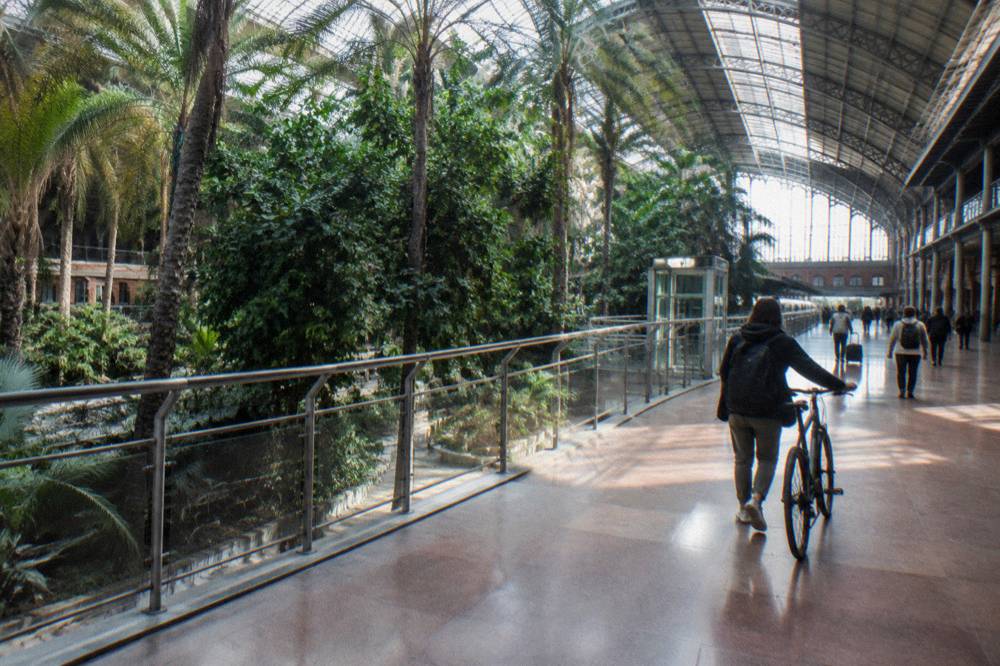
EMT city buses carry only a folded bike of hand-luggage size, one per bus, on the central platform, with wheelchair users having priority. Renfe trains treat a folding bike folded to 180 cm or less (height plus length plus width) as free hand luggage. For non-folding bikes on the Madrid metro, check Metro de Madrid directly; only folding bikes are confirmed as unrestricted on several sections.
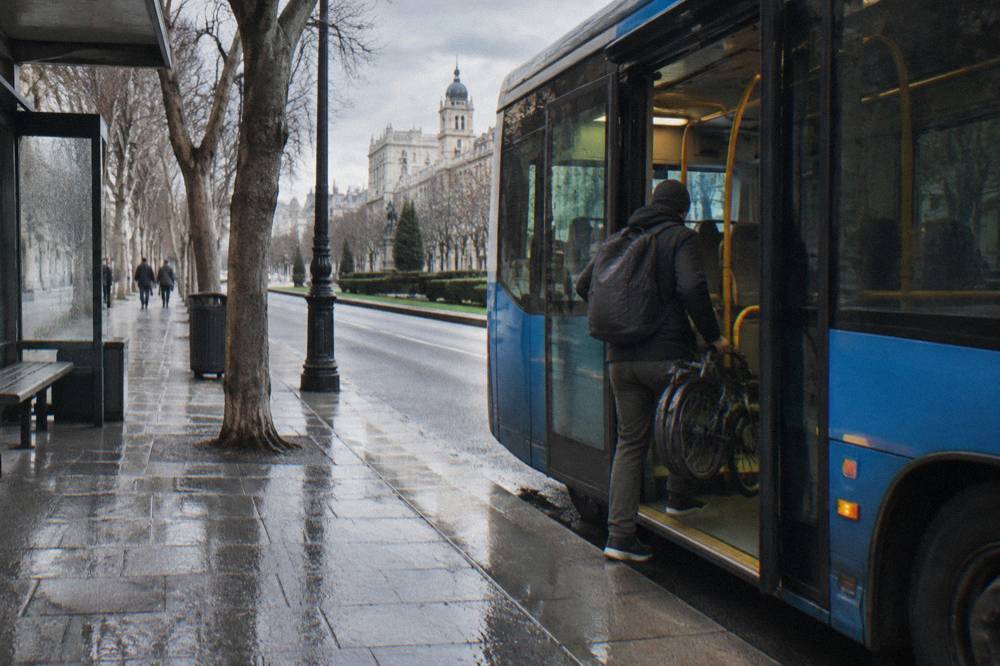
The bus rule is strict and enforced by layout: there is no rack, so only a bike that folds to luggage size boards, folded before stepping on, and only if the central platform has room. That largely rules out full-size bikes on most EMT lines.
The metro picture is genuinely murky, and this page will not pretend otherwise. The official Madrid tourism site confirms that folding bikes are allowed without a time limit on several sections and that non-folding bikes face a time restriction; the details of those restrictions are not reliably published in an accessible form, so the honest advice is to check Metro de Madrid before planning a non-folding bike trip on the underground. The Renfe bicycle rules page, by contrast, is clear: a folding bike within 180 cm folded is free hand luggage, which makes folder-plus-Cercanías a practical way to reach trailheads outside the centre.
| Mode | Bike policy | Source of the rule |
|---|---|---|
| EMT city bus | Folded hand-luggage-size bike only, one per bus, central platform | Ayuntamiento de Madrid |
| Renfe trains | Folding bike up to 180 cm (h+l+w) folded, free | Renfe official luggage rules |
| Metro de Madrid | Folding bikes allowed without time limit on several sections; non-folding bikes face a time restriction, details to check | esmadrid.com |
For tours this barely matters: guided rides start from fixed meeting points spread across more than four areas of the city, so no transit-with-bike question arises. The where tours start guide lists the meeting points and the metro stations that serve them.
Do You Need A Taxi Or Rideshare In Madrid?
Most visitors need a taxi only occasionally: late at night, with luggage, or in rain. The metro runs late, the centre walks well, and BiciMAD covers short hops for under a euro, so a taxi is a comfort purchase rather than a necessity. A flat airport fare is not mentioned, so confirm the price in the cab or app before setting off.
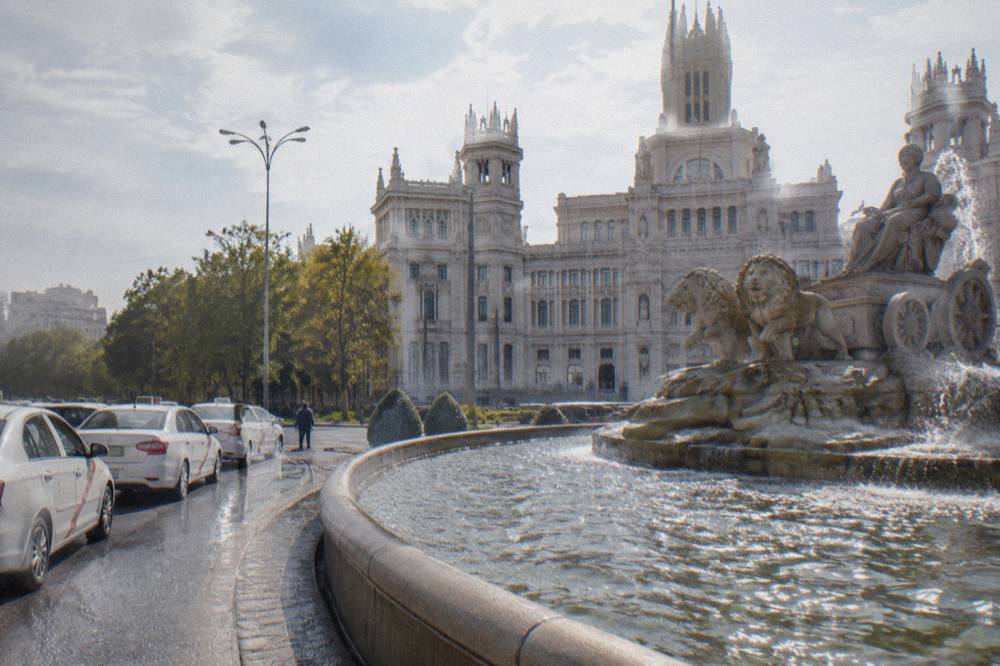
Taxis in Madrid are white with a red diagonal stripe, metered, and plentiful at ranks around Sol, Cibeles and the Palace. Rideshare apps operate legally alongside them. Prices are regulated but the fare depends on time, distance and supplements, and a typical figure for a centre-to-airport run is not mentioned here, so the rule is simple: check the meter or the app estimate first.
The realistic pattern for a sightseeing visitor: metro or BiciMAD by day, feet inside the old town, and a taxi twice in a trip, usually to or from the airport and once after a late dinner. Budgeting for the Tourist Travel Pass plus a couple of taxi rides covers most itineraries comfortably.
One pairing worth knowing: taxis solve the bike-and-transit gap that the bus and metro rules create. A rider who rents a non-folding bike and wants to move it across town cannot take it on an EMT bus and faces metro restrictions, so a taxi is the fallback, with the bike in the boot where it fits.
What Cycling Rules Apply In Madrid?
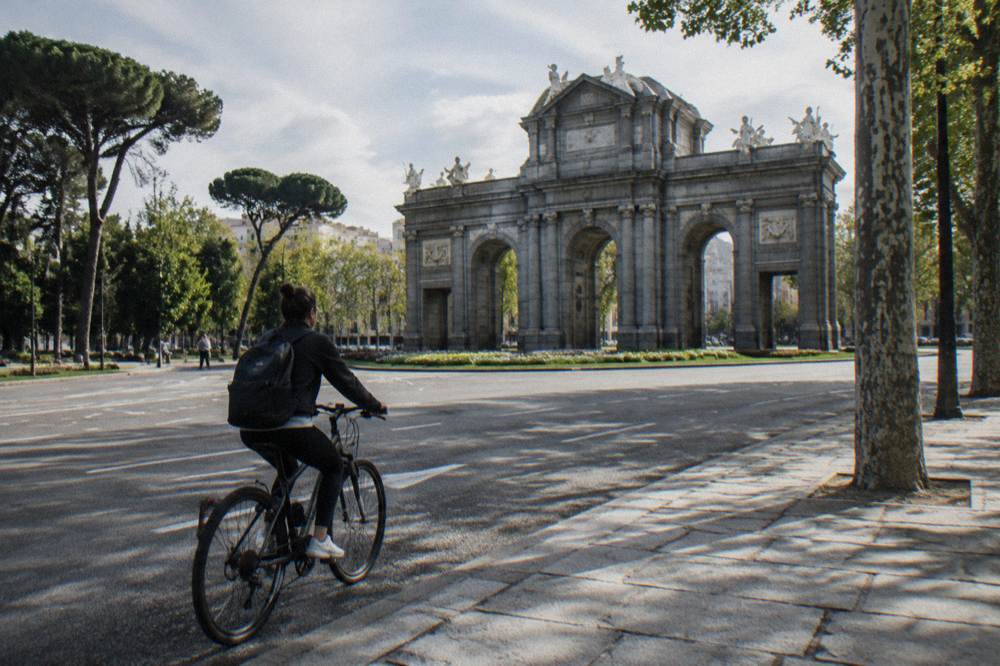
In the city, bikes ride on the carriageway, helmet use is mandatory for under-18s and recommended for adults, pavement riding is banned except on signed bike-pavements at 10 km/h, and bikes are prohibited on the M-30 and its access ramps. Nationally, from 1 October 2026 the helmet exemptions on interurban roads are removed, so every cyclist on those roads must wear one.
The city FAQ from the Ayuntamiento's cycling office sets the local frame: ride in the centre of the lane, two abreast allowed unless risky, no phone and no headphones connected to an audio device, red lights apply, and alcohol limits match other road users. The national text adds that motor vehicles must keep at least 5 m behind a cyclist in the same lane.
The 2026 reform changed one thing visitors on day trips out of the city should know: from 1 October 2026, overtaking a cyclist on an interurban road requires slowing at least 20 km/h below the limit, and the helmet exemptions on interurban roads are gone. For a tour in the city none of this bites; for anyone riding toward El Escorial or Segovia, the interurban helmet rule now applies to everyone. The two out-of-town e-bike tours on this site, the "Segovia E-Bike Day Ride" (from $63.14, 6 reviews) and the "El Escorial Nature and History" ride (from $45.92, 0 reviews), both include helmets, which matters under the new rule; neither has enough reviews yet to judge by rating alone.
In parks the numbers conflict between sources, so the safe wording is: ride slowly, pedestrians first. The one firm figure is Casa de Campo's 20 km/h cap on paved roads and wide dirt paths, with cross-country riding and trails off-limits. More details are available on the official park cycling page. The rules-of-the-road deep dive untangles the rest.
| Rule | Applies in Madrid city | Source |
|---|---|---|
| Helmet | Mandatory under 18, recommended for adults | Ayuntamiento de Madrid |
| Position | Carriageway, centre of lane; bike lanes optional unless signed | City cycling FAQ |
| Pavement | Banned, except signed bike-pavements at max 10 km/h | City cycling FAQ |
| Side by side | Two cyclists allowed per lane unless risky, not in bus lanes | City cycling FAQ |
| Motorways | Bikes prohibited on the M-30 and its accesses | City cycling FAQ |
| Casa de Campo | 20 km/h cap, paved roads and wide dirt paths only | esmadrid.com |
Which Combination Works Best For A Short Visit?
For a two or three day first visit, the strongest pattern is one guided bike tour on the first morning to learn the city's geography, a Zone A travel pass for cross-town trips, and walking plus BiciMAD for everything in the centre, reserving taxis for luggage and late nights. That mix typically costs less than relying on taxis alone and wastes the least time.
The reasoning is cumulative. A guided ride such as the "3-Hour Highlights Bike Ride" or the "Vintage Bike, Optional Tapas" tour delivers the whole sightseeing core in one morning and leaves a mental map that makes every later trip easier. The travel pass handles the airport connection and any long haul. BiciMAD at 0.50 EUR per first half hour covers the in-between distances where walking feels long and the metro feels indirect.
Families and hesitant riders adjust the mix. The bike tours with kids guide covers child-friendly options, and the beginners guide addresses the traffic-confidence question. Riders who prefer electric assist throughout can compare formats in the e-bike versus regular bike breakdown.
Madrid does not punish any single choice here. It punishes only the wrong expectations: expecting to ride a bike-share bike for four hours cheaply, expecting a non-folding bike on a rush-hour metro car, or expecting buses to be quick on Gran Vía. Get those three right and the city is unusually easy to move through, whether the goal is transport or simply seeing as much of it as possible in the daylight hours.
Common Questions About Getting Around Madrid
What Is The Fastest Way To Get Around Madrid?
The metro for long cross-city trips, with frequent trains on an extensive network; walking or a bike for the compact historic centre, where station spacing and traffic make surface options competitive door to door.
How Much Does Public Transport In Madrid Cost?
A Zone A Tourist Travel Pass costs 10.30 EUR for one day up to 43.20 EUR for seven days. It covers metro, buses and Cercanías in Zone A but not BiciMAD, which charges 0.50 EUR for the first 30 minutes per trip.
Can You Use BiciMAD Bikes As A Visitor?
Yes. Registration runs through the app with phone numbers from the EU, UK, US and several other countries. The basic fare is 0.50 EUR for the first 30 minutes, 0.50 EUR for the second 30, then 3 EUR per further half hour. The minimum age is 14.
Can You Take A Bike On Madrid Buses And Trains?
EMT buses accept only a folded bike of hand-luggage size, one per bus. Renfe treats a folding bike within 180 cm folded as free hand luggage. For non-folding bikes on the metro, check Metro de Madrid; only folding bikes are confirmed as unrestricted on several sections.
Do You Need A Helmet To Cycle In Madrid?
In the city, a helmet is mandatory for riders under 18 and recommended for adults. On interurban roads the exemptions were removed from 1 October 2026, so all cyclists must wear one there. Guided tours that list a helmet in their inclusions provide it.
Is A Guided Bike Tour A Good Way To See Madrid?
For a first visit it is efficient: standard group rides cover the centre's main sights in about three hours from $29 to $45 per person, with bike and guide included and free cancellation per the booking page. The most reviewed of the 29 tours on this site rates 4.9 across 1,989 reviews.