Madrid Río Park Guide: Where It Runs And What To See
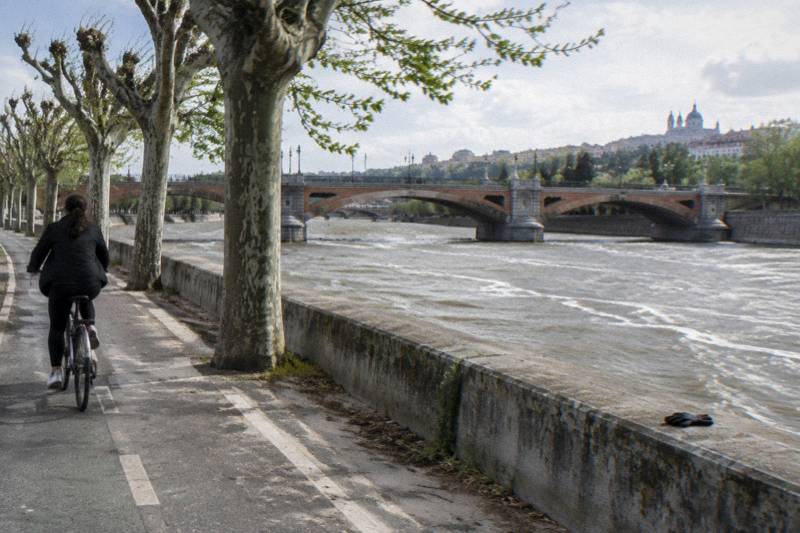
Madrid Río turned a buried motorway trench into a ribbon of parks, bridges and playgrounds along the Manzanares, and it is now one of the flattest, easiest places to ride a bike in the Spanish capital.
Short answer
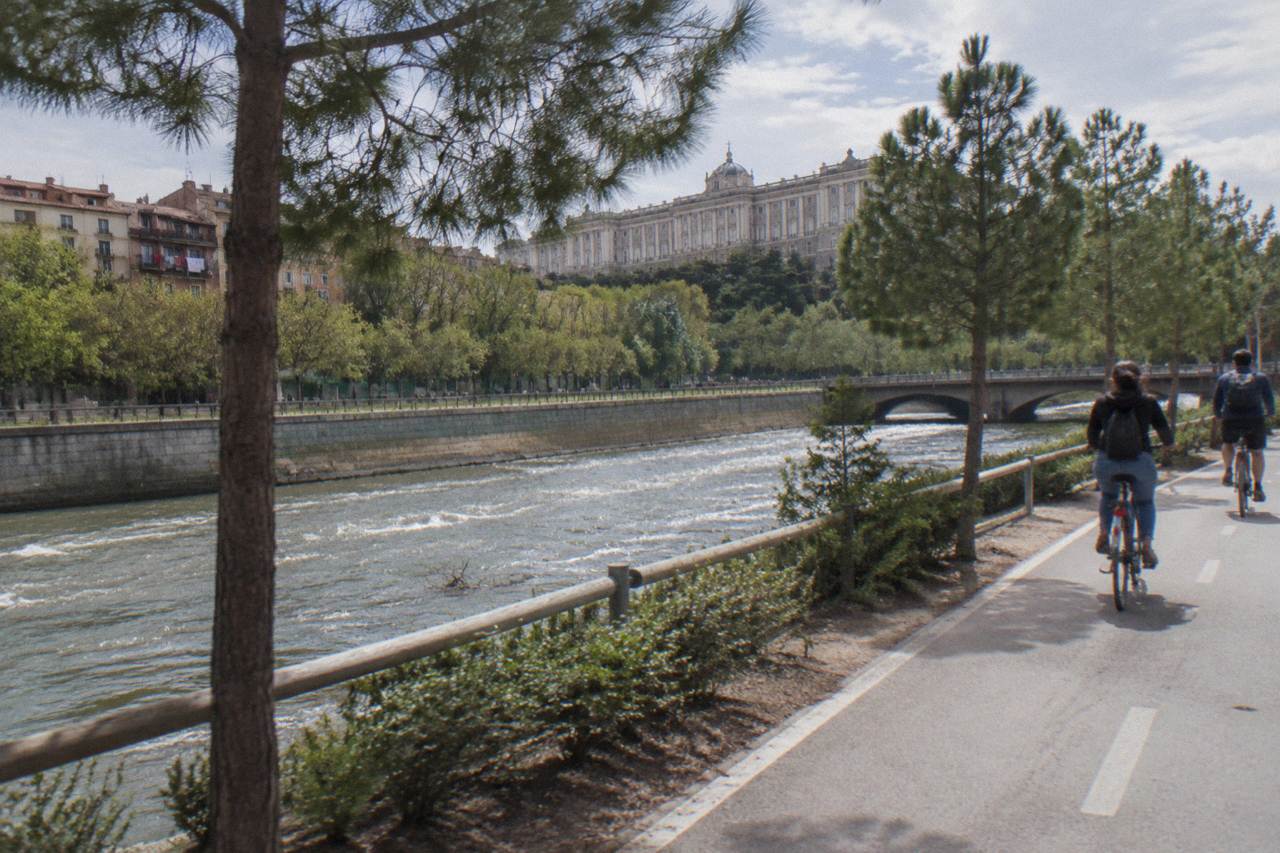
Madrid Río is the chain of riverside parks built over the Manzanares after the M-30 motorway was tunnelled underground. It links Matadero Madrid, the Puente de Segovia and Puente de Toledo bridges, and the green corridor toward Casa de Campo, all on flat, traffic-separated paths that guided riverside bike tours ride from about $40 per person.
What Is Madrid Río And Why Does It Matter?
Madrid Río is a linear park system running along the Manzanares river, created by burying the M-30 motorway in tunnels and rebuilding the surface above it as paths, playgrounds, groves and plazas. It matters because it turned a riverfront once dominated by traffic into public space where people walk, play and gather. It stitched together the historic river bridges, the Matadero Madrid cultural centre and the edges of Casa de Campo into one continuous green corridor on mostly flat ground. For cyclists it matters because it is one of the few places in central Madrid where you can ride for a long stretch without sharing space with cars, which is exactly why several guided bike routes include it.
Before the motorway went underground, the river was a noisy barrier between the city centre and the western neighbourhoods. Today the trench is gone, and in its place runs a sequence of themed gardens, pine groves, fountains and sports areas connected by walking and cycling paths on both banks.
For visitors the practical appeal is simple. Central Madrid is hilly in parts, with cobbles and busy avenues, but the river corridor is level, wide and signposted. Families, casual riders and anyone nervous about Spanish traffic all find the riverside the easiest place in the city to turn pedals, and the tour operators that run parks-and-river routes know it. The corridor also connects directly into Casa de Campo, the huge wooded park to the west at the corridor's northern end near Príncipe Pío, so a single ride can cover water, pines and palace views in one loop.
The site's broader parks coverage includes a dedicated Casa de Campo bike tour guide and a route-focused Madrid Río bike ride overview, if you want to go deeper on either half of the corridor.
Where Does Madrid Río Start And End?
The park runs along the Manzanares from roughly the area behind the Royal Palace and Príncipe Pío in the north to the Pasarela de la Arganzuela and the southern bridges near the M-30's surface sections, linking the centre with Casa de Campo and the Arganzuela districts. Rather than one square park, think of it as a chain: each section has its own name, character and entrances, and the cycling path threads through all of them continuously on both banks. You can join or leave at many points, which is why guides use it so readily.
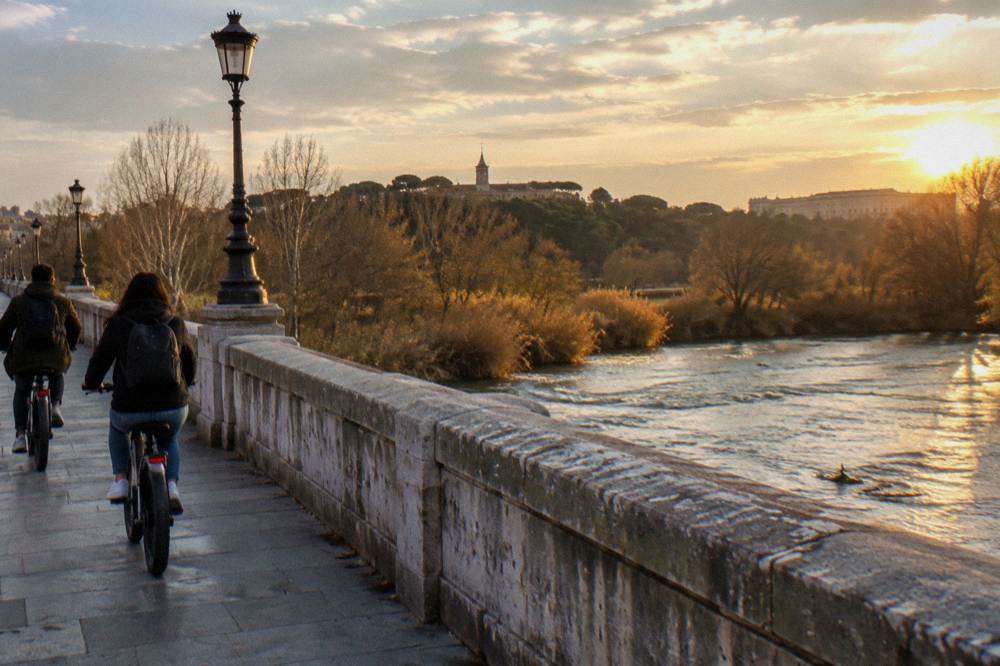
At the northern end the corridor sits close to the cathedral and the palace hill, near where the Cuesta de la Vega drops toward the river. From there the path passes under and beside the historic stone bridges: the Puente de Segovia, the oldest of them, and the Puente de Toledo, an ornate baroque crossing with sculpted portals that is probably the single most photographed spot on the route. Between the two, the Salón de Pinos is a formal pine promenade designed as the park's spine.
- City Highlights Rides$29
- Parks And Madrid Río Rides$33.29
- Night And Sunset Rides$40.18
- Day Trips From Madrid$40.18
- E-Bike Tours$41.33
- Private Bike Tours$43.63
South of the Puente de Toledo the character softens. The Parque de la Arganzuela sits on the east bank around the Matadero Madrid, the former slaughterhouse turned cultural centre, with lawns, water gardens and the playful Puente de Arganzuela footbridge coiling over the river. At its northern end, the corridor blends into the open ground that leads toward Casa de Campo, the city's largest green space, west of the river.
A rough orientation for a first visit:
| Zone of Madrid Río | Character | What stands out |
|---|---|---|
| Northern end near Príncipe Pío | Steep-banked, views up to the palace | Closest access from the centre |
| Salón de Pinos | Formal pine promenade | Straight, shaded riding line |
| Puente de Toledo reach | Historic baroque bridge | The classic photo stop |
| Parque de la Arganzuela | Lawns, water gardens, cultural hub | Matadero Madrid next door |
| Southern links toward Casa de Campo | Open, quieter, greener | Continues into the big park |
No official length figure is printed here; the corridor is long enough that most riders treat it as a one-way drift with a return by the opposite bank, and guided tours simply ride the best segments. If a riverside loop sounds like your pace, the options below cover it.
The three rides above share the family-friendly, flat-and-green logic of the corridor. The riverside specialist is the two-hour "Casa de Campo E-Bike" tour, which pairs the Manzanares banks with the big park in a single loop, and there is a fuller look at it in the section on choosing a tour below.
What Can You See Along Madrid Río?
The highlights along Madrid Río are the historic bridges (Segovia and Toledo), the pine promenade of the Salón de Pinos, the water gardens and lawns of the Parque de la Arganzuela, the Matadero Madrid cultural centre, playgrounds and fountains, and views up toward the Royal Palace and the Almudena Cathedral from the northern end. None of it needs a ticket; the park is public space, and the sequence reads well from a bike because the path passes each landmark in a natural order. Expect a mix of garden design, old stone engineering and ordinary Madrid life, with locals jogging, rowing on the lake at Casa de Campo and filling the playgrounds on weekends.
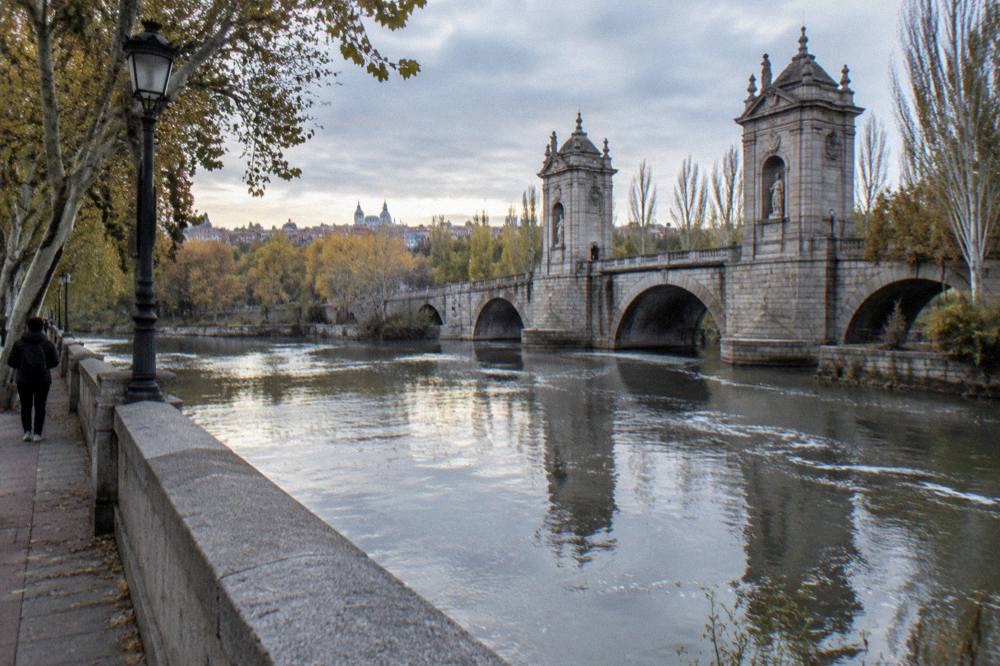
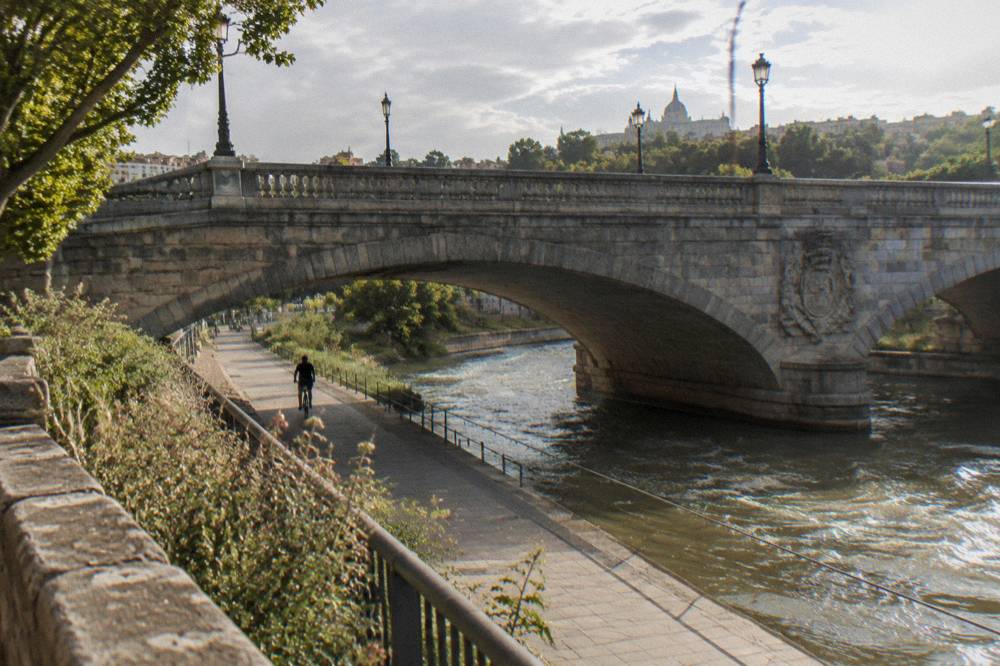
The bridges deserve a slow pass. The Puente de Segovia is the oldest crossing on this stretch of the river, rebuilt and widened repeatedly over the centuries, and its stone arches frame the Manzanares best in low light. The Puente de Toledo carries two baroque portals and statues from the era of the city's royal building campaigns; riding across it is the moment the park feels least like a modern project and most like old Madrid. Between crossings, modern footbridges, including the coiled Puente de Arganzuela, add contemporary counterpoints.
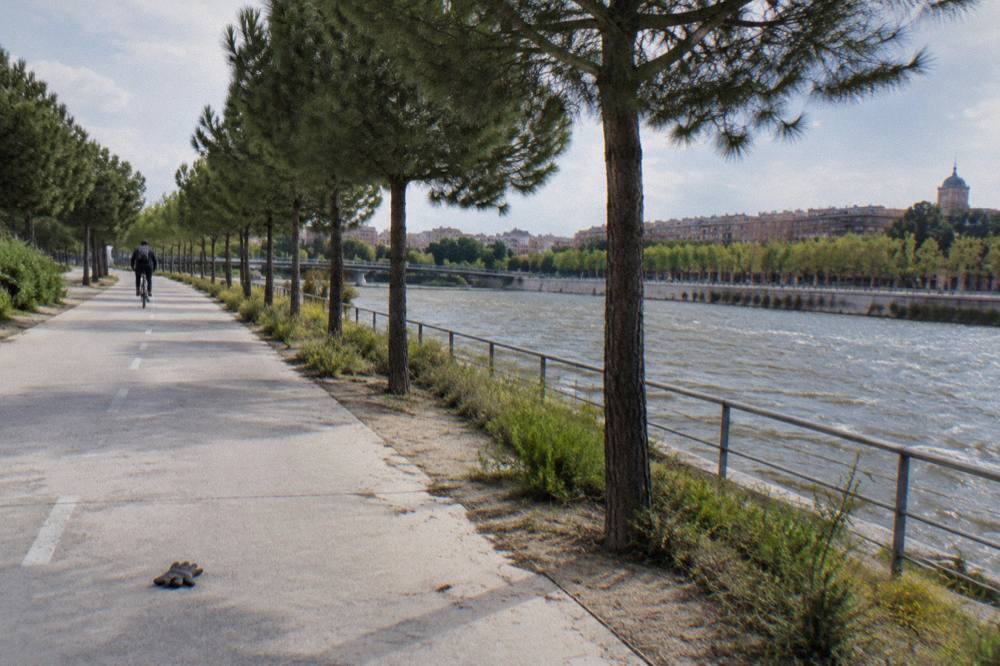
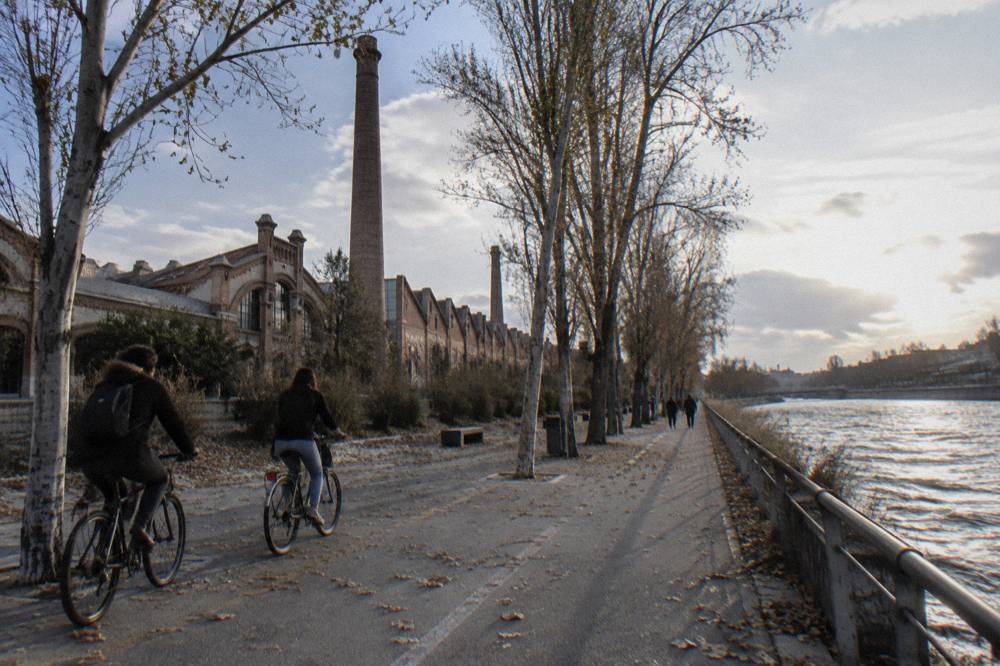
The green spine, the Salón de Pinos, plants pines in a disciplined grid along the western bank, and it is the shadiest stretch on a summer afternoon. South of it, the Parque de la Arganzuela's water gardens run water through shallow channels and basins that children wade in, and the lawns around the Matadero, the red-brick former abattoir now hosting exhibitions and events, give the southern half its cultural anchor. Príncipe Pío station sits at the north-west corner, which matters for getting there.
A compact hit list for a self-guided drift:
| Stop | Type | Why stop |
|---|---|---|
| Puente de Segovia | Historic bridge | Oldest crossing, stone arches |
| Salón de Pinos | Pine promenade | Shade, straight riding |
| Puente de Toledo | Baroque bridge | Statues, portals, photos |
| Parque de la Arganzuela | Water gardens, lawns | Fountains, picnic spots |
| Matadero Madrid | Cultural centre | Red-brick industrial architecture |
| Casa de Campo edge | Big park | Lake, woods, cable car views nearby |
If you would rather have someone else handle the route and the bike, the question below covers the guided options.
Can You Cycle In Madrid Río Park?
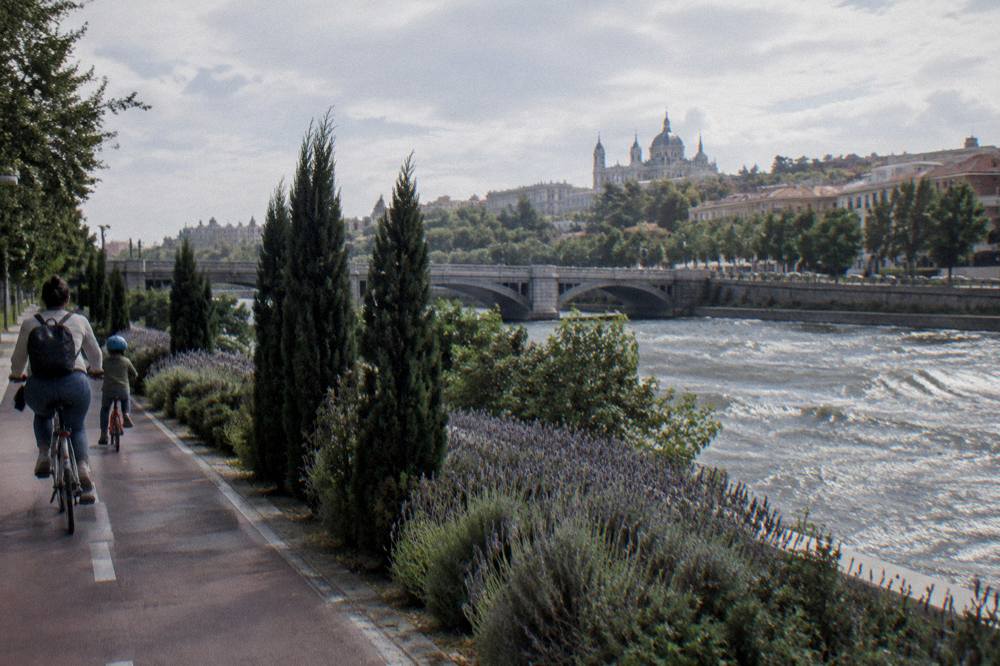
Yes, cycling is allowed and normal throughout Madrid Río on the paved paths, subject to the city's park rules: ride slowly around pedestrians, give way to people on foot, and keep off planted areas. The paths are wide, flat and largely separated from traffic, which is precisely why the riverside features on so many guided itineraries. The rules that matter are the ordinary Madrid ones: the city's cycling FAQ confirms bikes belong on the carriageway in the street network, and inside parks pedestrian priority governs, so the working rule on the river paths is simple, slow and courteous.
For the specifics, the Ayuntamiento's Oficina de la Bici FAQ sets out the city rules: bikes use the carriageway or optional bike lanes on streets, pavements and pedestrian zones are closed to bikes except signed bike-pavements, and in parks the paths are shared with pedestrians first. Helmets are mandatory for riders under 18 in Madrid and recommended for adults; the guided tours that include a helmet list it on their booking pages, and several riverside options provide one.
The corridor links to Casa de Campo, where the rules tighten slightly: the official guidance for cycling in Casa de Campo sets a 20 km/h speed cap, restricts riding to paved roads and wide dirt paths, and bans cross-country trails. That cap is the one hard number a rider needs to remember, and it applies to the big park rather than the river gardens. For families the combination works well: flat riverside paths for warm-up, then the park's quiet roads for distance.
A few practical points round this out. Guided e-bike itineraries ride the same paths, among them the River Side & Casa de Campo Electric Bike Tour, 2 hours from $44 per person. Night riding happens too, with front and rear lights required after dark under city rules, and a sunset riverside ride is a favourite format; the site's Madrid sunset bike tour guide covers that angle. In short: yes, ride it, just yield to feet.
The semi-private Retiro e-bike option above is the contrast case: a small-group, two-hour electric ride capped at eight riders that shows the east-side park rather than the river, useful if your Madrid itinerary leans toward Retiro and the galleries. Its rating, 4.1 across 28 reviews, is honest mid-table rather than stellar, so weigh the format, not the score. The full index of guides sits on Madrid Bike Tours.
Which Bike Tour Covers Madrid Río?
The tours that ride the riverside are the "Casa de Campo E-Bike" tour (2 hours, from $44.00 per person, 4.6 across 107 reviews), the "Parks and Riverside Bike Ride" (3 hours 15 minutes, from $40.18 per person, 4.8 across 29 reviews), and the "Bike or E-Bike Parks Ride" (2 hours, from $40.18 per person, 4.9 across 18 reviews), all starting from fixed central meeting points with free cancellation on their booking pages. Each pairs the Manzanares corridor with Casa de Campo, because the two sit next to each other and make a natural loop. The differences are duration, bike type and group size.
The "Casa de Campo E-Bike" tour is the focused one: two hours on an electric bike from Calle de Santiago 18, in the Palacio quarter near Sol and Opera, aimed at riders who want the river-and-park combination without a long commitment. Its 107-review history at 4.6 gives it one of the larger review pools among the parks options, and bottled water is not listed among its inclusions, so bring your own on a warm day. The "Parks and Riverside Bike Ride" is the fuller version: 3 hours 15 minutes, capped at 10 riders, letting each rider choose a regular bike or an e-bike, with helmet and guide included, from $40.18 per person.
The "Bike or E-Bike Parks Ride" covers similar ground in two hours with a larger cap of 25 riders at the same from-price of $40.18 per person, and its 4.9 across 18 reviews is strong but from a small pool, worth knowing before weighting the score. All three offer free cancellation, which matters if Madrid's weather shifts; check the policy detail on the booking page. Here is the comparison at a glance:
| Tour | Duration | From price | Rating and reviews | Group cap | Bike |
|---|---|---|---|---|---|
| Casa de Campo E-Bike | 2 hours | $44.00 | 4.6, 107 reviews | Not stated | E-bike |
| Parks and Riverside Bike Ride | 3 hours 15 minutes | $40.18 | 4.8, 29 reviews | 10 | Regular or e-bike |
| Bike or E-Bike Parks Ride | 2 hours | $40.18 | 4.9, 18 reviews | 25 | Regular or e-bike |
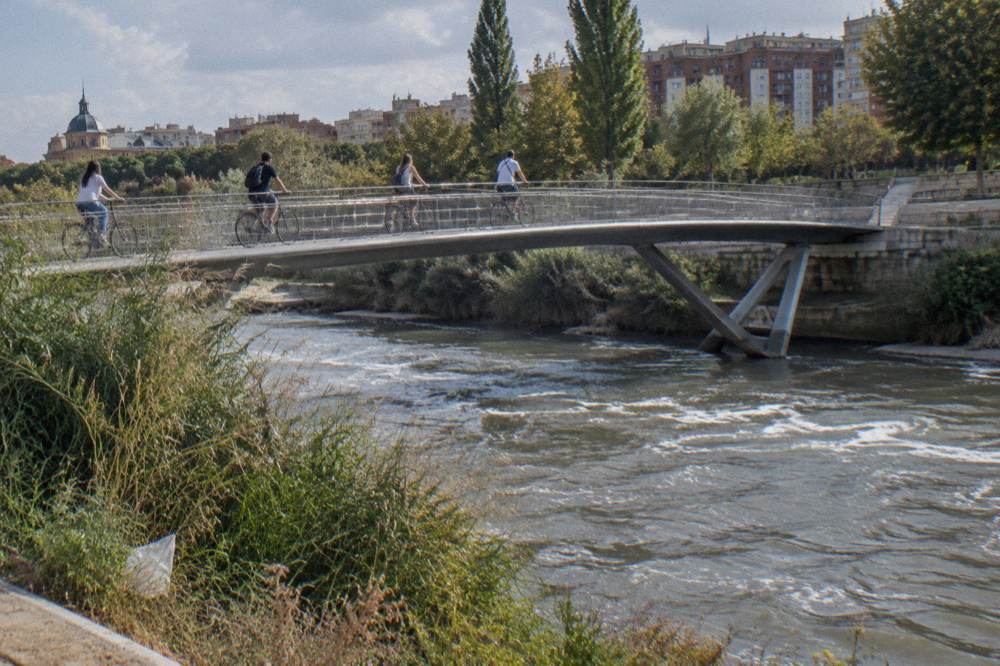
The riverside specialist itself is worth a closer look. The Casa de Campo E-Bike tour covers the river side and the park in one two-hour loop on electric bikes, with a guide, from $44.00 per person, and check availability if the dates line up with your trip.
For a longer, slower afternoon, the Parks and Riverside Bike Ride tour page details the 3 hour 15 minute version with its ten-rider cap, and Check availability there too. Beyond these three, none of the city's other 3-hour highlights rides lists the river corridor as its focus, so if Madrid Río is the point of your day, the parks-and-river family is the one to book.
When Is The Best Time To Ride Madrid Río?
The most comfortable months to ride Madrid Río are April, May, June, September and October, when mean daytime highs sit between 18 and 28 °C and rain days stay modest; July and August are rideable but hot, with mean maxima of 32.1 °C and 31.3 °C, and the corridor's shade becomes the main attraction. The figures come from the AEMET climate normals recorded at Madrid Retiro: the year averages 15.0 °C, with about 100 clear days and rain concentrated in October (60 mm) and November (58 mm). Winter riding works too, with January means of 6.3 °C, provided you layer up.
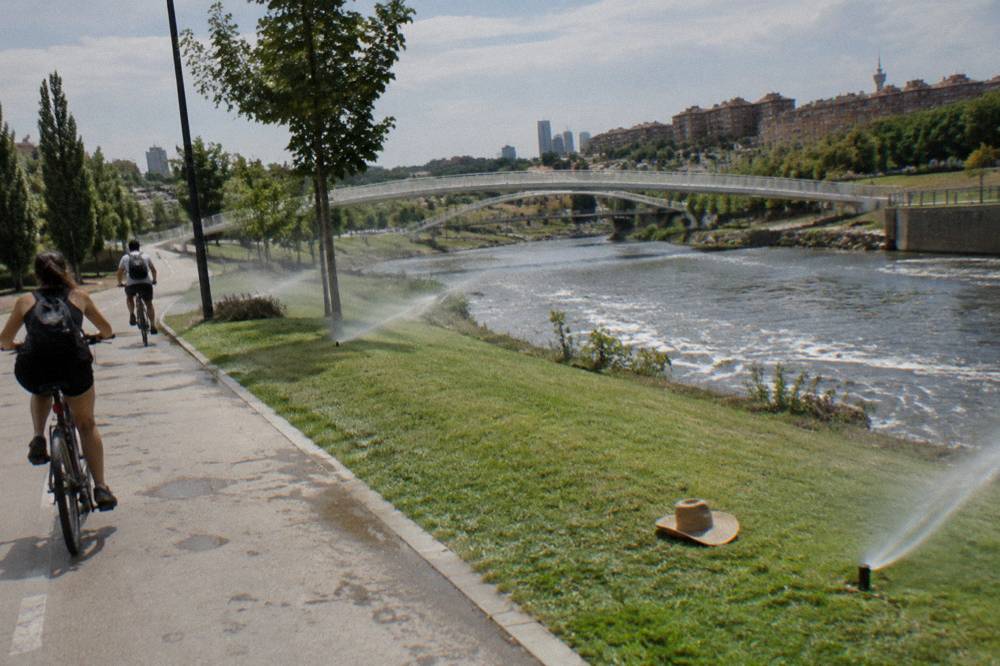
The rhythm of the day matters as much as the month. In summer the pine promenade and the water gardens hold shade through the middle hours, but guided tours still favour morning and evening slots, and a sunset riverside format exists for exactly this reason. In spring the lawns fill with families by midday on weekends, so early rides get emptier paths. October, the wettest month, rewards a flexible plan and a rain check on the cancellation policy rather than a firm schedule.
| Month | Mean temp C | Mean daily max C | Rain mm | Rain days |
|---|---|---|---|---|
| March | 11.2 | 16.3 | 25 | 4.1 |
| April | 12.9 | 18.2 | 45 | 6.7 |
| May | 16.7 | 22.2 | 50 | 7.3 |
| June | 22.2 | 28.2 | 21 | 3.4 |
| July | 25.6 | 32.1 | 12 | 1.7 |
| August | 25.1 | 31.3 | 10 | 1.7 |
| September | 20.9 | 26.4 | 22 | 3.3 |
| October | 15.1 | 19.4 | 60 | 6.9 |
For heat-specific tactics, including what to wear and how to time a summer ride, the site's cycling in Madrid summer heat guide goes deeper, and the month-by-month breakdown lives in the Madrid weather by month guide.
How Do You Get To Madrid Río?
The main access points are Príncipe Pío station at the north-west corner, the Puerta de Toledo area on the east bank, and the Legazpi side at the southern end, all served by metro and suburban rail, with the BiciMAD bike-share network docking nearby since the corridor sits inside the city's 21-district, 683-station system. From the centre, Príncipe Pío is the handiest gateway: it is a large interchange, and from its river side you drop almost straight onto the northern paths. La Latina and Puerta de Toledo serve the middle reaches, and Legazpi or Arganzuela stops cover the south.
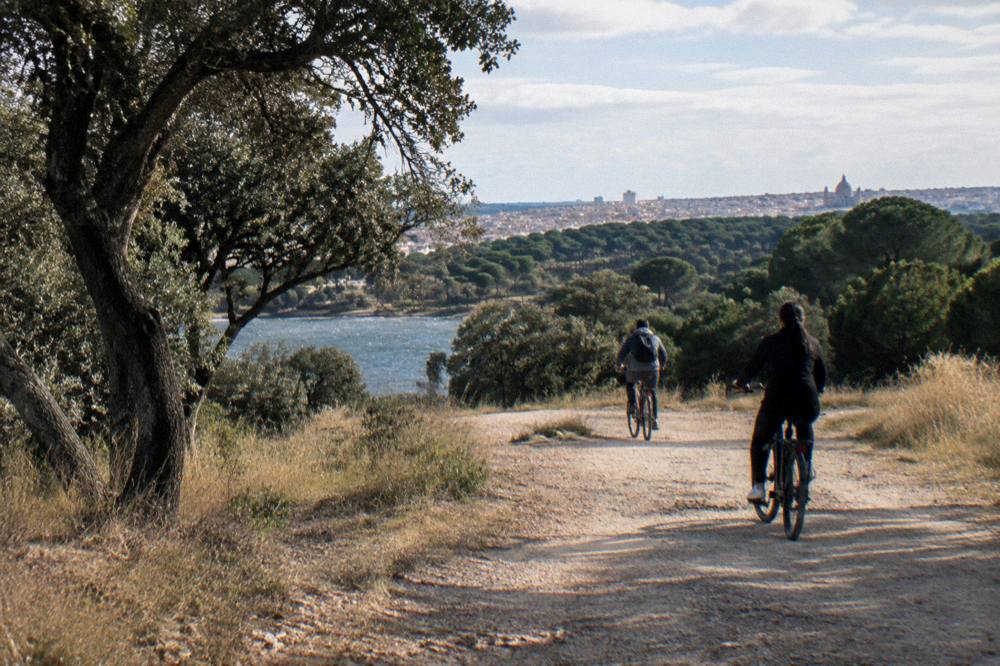
If you arrive by bike-share, BiciMAD's official site sets out the terms: electric bikes from 683 stations across 21 districts, 0.50 EUR for the first 30 minutes and 0.50 EUR for the second 30, then 3 EUR per further half hour, with a 10 EUR monthly pass for unlimited trips up to 30 minutes. Minimum age is 14, helmets are mandatory for under-18s on the system, and the tourist Travel Pass does not include BiciMAD, a common assumption worth correcting before you plan a share-bike day. One catch for the river-and-park loop: there is no BiciMAD station inside Casa de Campo, the nearest docking sits at Príncipe Pío, so plan the return leg accordingly.
Bringing your own or a rental bike on transit has limits. City buses carry only a folded bike of hand-luggage size, one per bus. Renfe treats a folding bike as free hand luggage up to 180 cm added dimensions when folded, per its bicycles and luggage rules. For metro, folding bikes are allowed without a time limit on several sections and non-folding bikes face time restrictions, so check Metro de Madrid before carrying a full-size bike underground.
Guided tours remove the logistics entirely: the riverside options meet at fixed addresses, Calle de Santiago 18 for two of them and C. de Juan Álvarez Mendizábal 19 for the third, all central and all a short walk or ride from the river. That is a fair part of what the ticket buys.
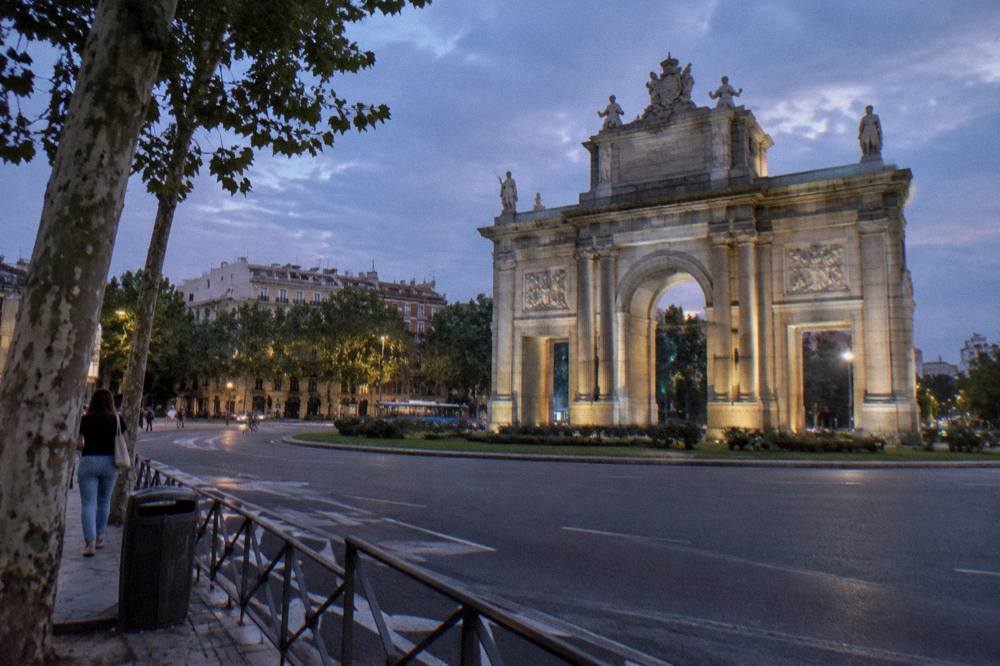
Whether you drift the river banks on your own or hand the route to a guide, the corridor rewards a slow pace and a return by the opposite bank: the views are different each side, and the bridges look better the second time across.
Common Questions About Madrid Río
What Is Madrid Río?
Madrid Río is a chain of riverside parks along the Manzanares, built on the surface after the M-30 motorway was tunnelled underground. It links historic bridges, gardens, playgrounds and the Matadero Madrid cultural centre with the edge of Casa de Campo.
Can You Cycle In Madrid Río Park?
Yes. Cycling is allowed on the paved paths throughout the corridor, with pedestrian priority and a slow pace expected around people on foot. Guided tours ride the paths daily, and e-bikes are common. In neighbouring Casa de Campo the speed cap is 20 km/h on paved roads and wide dirt paths.
Which Bike Tour Covers Madrid Río?
The Casa de Campo E-Bike tour (2 hours, from $44.00 per person, 4.6 across 107 reviews), the Parks and Riverside Bike Ride (3 hours 15 minutes, from $40.18 per person, 4.8 across 29 reviews) and the Bike or E-Bike Parks Ride (2 hours, from $40.18 per person, 4.9 across 18 reviews) all pair the river corridor with Casa de Campo.
When Is The Best Time To Ride Madrid Río?
April, May, June, September and October offer the best balance of warmth and low rainfall, with mean daily highs between 18 and 28 °C. July and August are hot, with mean maxima above 31 °C, so favour morning or sunset hours. October is the wettest month at 60 mm.
How Do You Get To Madrid Río?
Príncipe Pío station serves the north-west corner, Puerta de Toledo the middle, and Legazpi the southern end. BiciMAD bike-share docks nearby, though there is no station inside Casa de Campo; the nearest docking is at Príncipe Pío.
Is Madrid Río Suitable For Families And Beginners?
Yes. The paths are flat, wide and separated from traffic, which makes the corridor one of the easiest places to ride in central Madrid for children and nervous riders. Several tours cap groups at 10 or fewer, and e-bike options reduce the effort further.