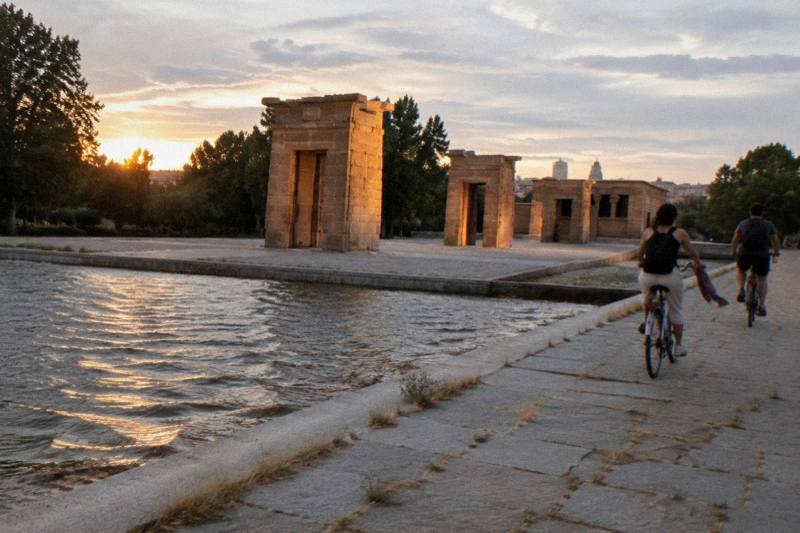
Temple Of Debod At Sunset: Timing And Nearby Views
The Temple of Debod is the single most photogenic sunset stop in Madrid, and the bike lanes and park paths around it make it an easy one to reach on two wheels.
Short answer
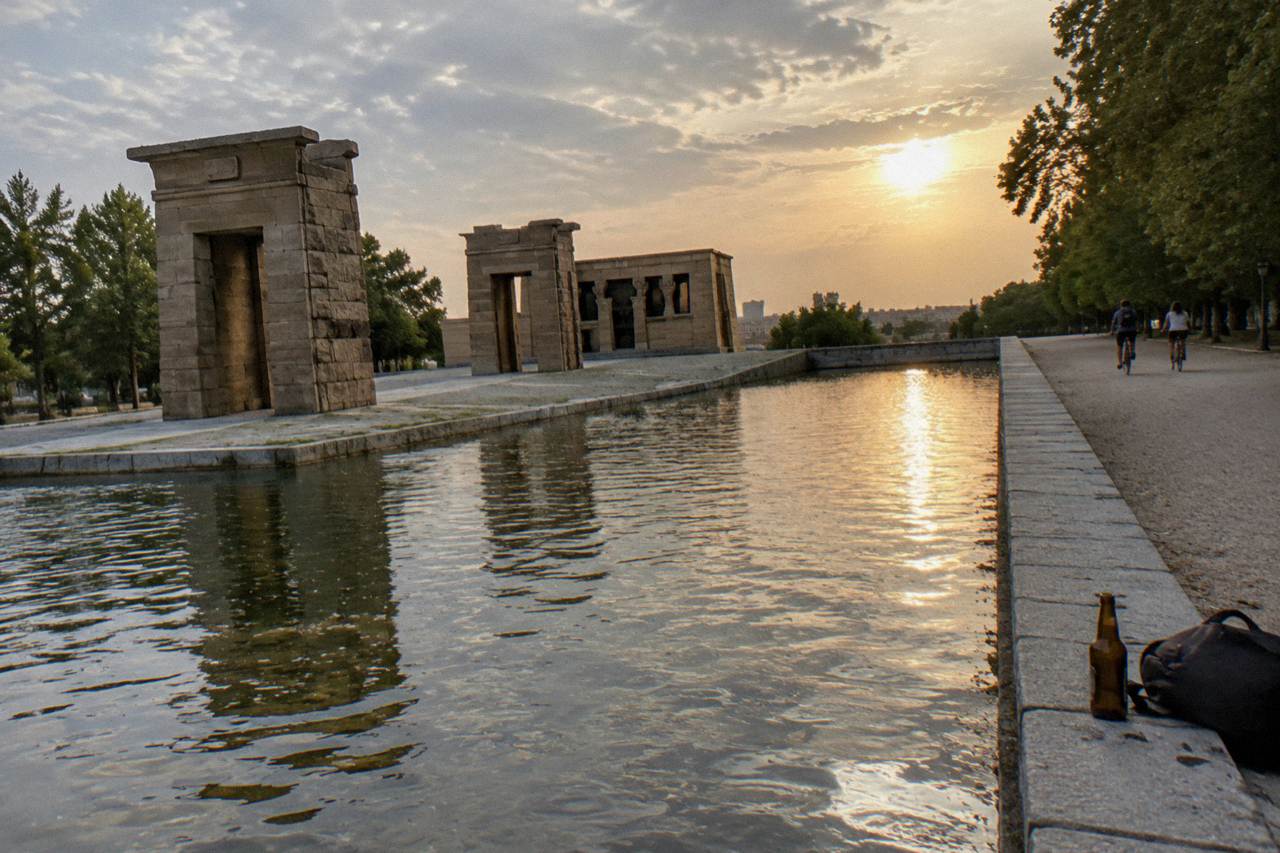
The Temple of Debod is an ancient Egyptian temple in the Parque de la Montaña, west of the Royal Palace, and its mirador is a classic sunset stop. Two evening options are the Sunset-Chasing Bike Ride, from $40.18 per person, and the Sunset and Night Lights E-Bike, from $45.00 per person, though neither tour description names the temple as a guaranteed stop.
Madrid has plenty of viewpoints, but only one where an ancient Egyptian temple sits silhouetted against a fading sky above the Casa de Campo. The Temple of Debod draws photographers, couples and tour groups to the Parque de la Montaña every clear evening, and the crowds build fast because the good spots on the mirador terrace are limited. Arriving by bike changes the equation: you skip the uphill walk from the city centre, you can time your arrival instead of guessing, and when the show is over you roll downhill toward the Royal Palace and the lit-up Gran Via rather than queueing for a bus.
This guide covers what the temple actually is, how sunset timing works across the year, which guided rides pass the area, how to reach it on the city's lanes and paths, and what the weather does to an evening plan. The temple area is a classic sunset stop on the evening rides covered on Madrid Bike Tours, and the sections below pair the stop with the tour options that fit it best.
What Is The Temple Of Debod?
The Temple of Debod is an ancient Egyptian temple donated to Spain by Egypt, rebuilt stone by stone in Madrid's Parque de la Montaña, and now one of the city's most recognisable monuments, standing west of the Royal Palace above the Manzanares river. The temple sits on one of the few high terraces in central Madrid with a clear view toward the western horizon. That combination, an exotic silhouette plus an unobstructed sunset angle over the Casa de Campo, is why the spot has become the classic evening photograph in the city.
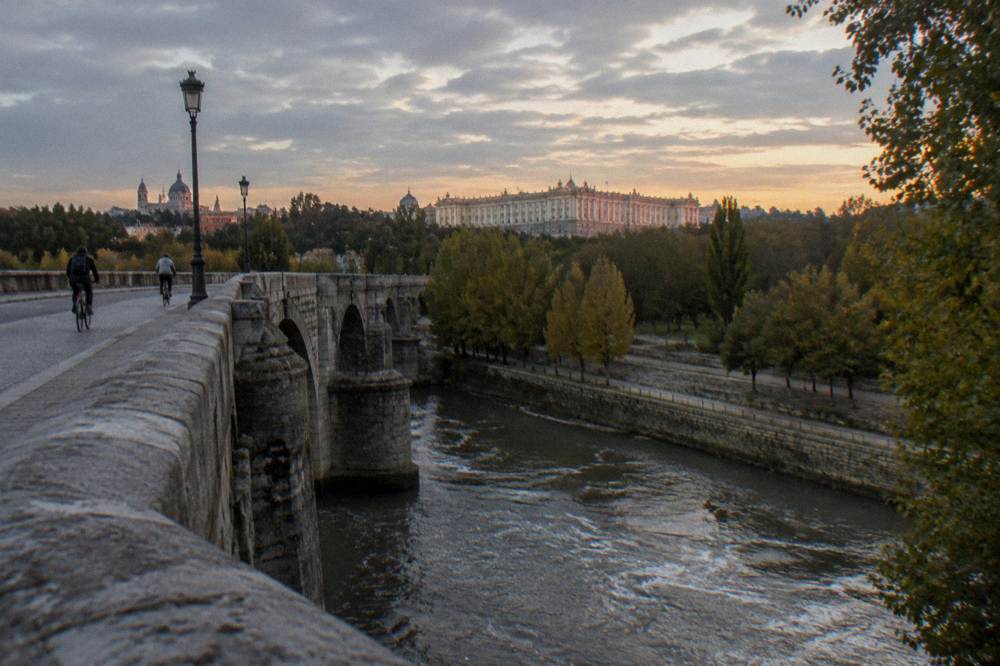
The monument is surrounded by a pool of water that mirrors the stones at dusk, and the terrace around it works as a public mirador. People spread along the ledge with picnics and cameras in the last hour of daylight, and on warm evenings the atmosphere is closer to a small open-air gathering than a solemn monument visit. The leafy, low-traffic Parque del Oeste slopes down below the temple toward the Madrid Río park and the river, which is exactly why cyclists end up here naturally on evening routes.
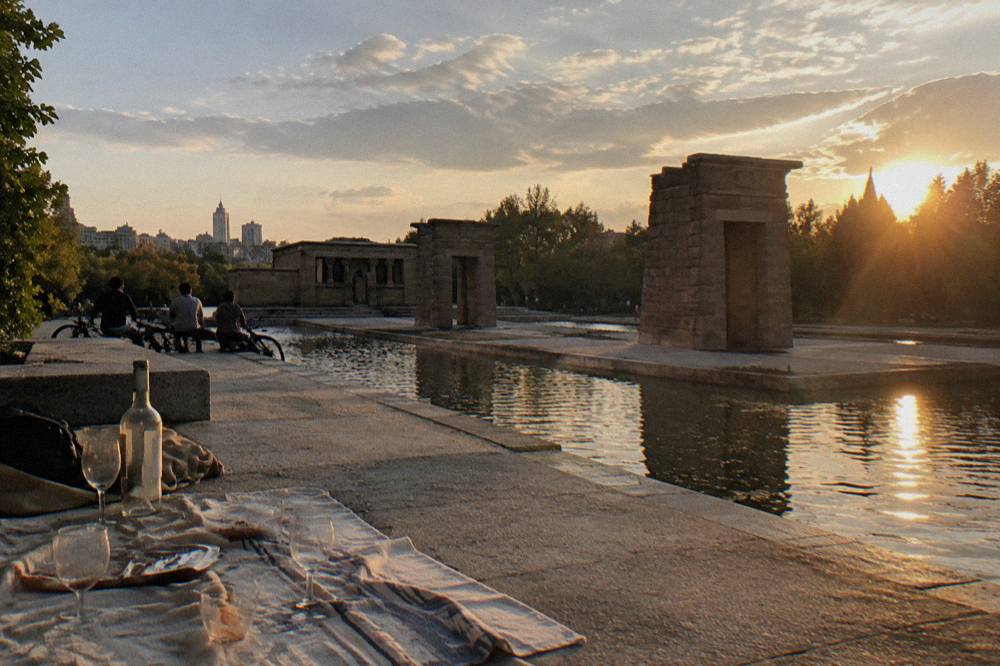
For a bike-based plan, three things matter. First, the approach is uphill from the city centre and from the river, so an e-bike or a relaxed pace is the realistic choice in summer heat. Second, the terrace itself is a pedestrian space, so bikes are parked or walked at the edge rather than ridden onto the mirador; the city's cycling FAQ is explicit that pavements and pedestrian zones are closed to bikes except signed bike-pavements. Third, the temple sits at a junction of several pleasant riding corridors, so it slots neatly into a loop that takes in the Royal Palace, the Parque del Oeste and the river path in one evening.
The interior of the temple is a separate matter from the terrace: the monument itself has its own visiting arrangements, and this guide deliberately prints no entry hours or ticket details, since those change and are best confirmed on official city channels before you go. The sunset view from outside is free and always has been, and that is the part a bike tour uses.
- City Highlights Rides$29
- Parks And Madrid Río Rides$33.29
- Night And Sunset Rides$40.18
- Day Trips From Madrid$40.18
- E-Bike Tours$41.33
- Private Bike Tours$43.63
When Is The Best Time Of Day To Visit The Temple Of Debod?
The best time is the last 60 to 90 minutes before the sun drops below the Casa de Campo ridge to the west, which is when the sky colours develop, the stones silhouette and the terrace fills up; arriving early means a pick of spots, arriving late means a crowd and a rushed photo. Exact sunset times shift week by week across the year and are not printed here, so check a weather app or astronomical table for the date of your visit and work backwards about an hour. On a guided sunset ride the guide makes that calculation for you, which is half the appeal.
Season changes the experience more than most visitors expect. In summer the evenings are hot and long, and AEMET's climate normals for Madrid's Retiro station put the July mean daily maximum at 32.1 °C, so a 20:00 terrace crowd is a hot one; bring water and ride the approach gently. Spring and autumn are the sweet spots, with milder evenings and a higher chance of the partly cloudy skies that make a sunset dramatic rather than a plain orange disc. Winter sunsets come early enough to fit before dinner, but January's mean temperature of 6.3 °C means gloves and a layer.
Cloud cover decides everything, and October and November are the wettest months in the city, at 60 and 58 mm of rain respectively in the long-term averages. A heavily overcast evening kills the classic shot, though the temple still photographs well in blue-hour light with the city glowing behind it. The alternative plan for a cloudy day is simple: ride the same loop, skip the terrace wait, and let the city lights be the show instead, which is roughly what the night-rides segment of the tour options does.
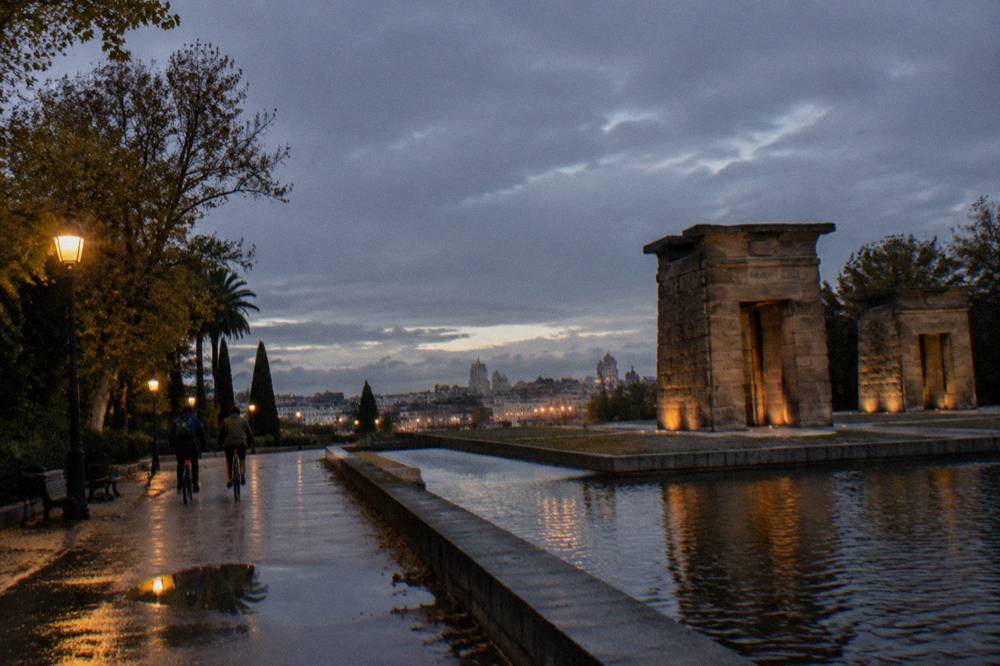
If you are planning the visit independently, a practical rhythm looks like this: ride up through the Parque del Oeste or from the Madrid Rio path in the last two hours of daylight, secure a spot on the terrace ledge, watch the sun drop, then descend east toward the Royal Palace and Plaza de Oriente as the street lights come on. The whole loop fits comfortably inside two hours of riding at a tourist pace. For timing questions that go beyond one viewpoint, the broader best time to cycle in Madrid guide breaks the year down month by month.
If you would rather hand the timing to a guide, these are the three evening-friendly rides that pair best with a Debod stop.
Which Madrid Bike Rides Pass The Temple Of Debod?
Evening options include the Sunset-Chasing Bike Ride, a 2-hour regular-bike tour from $40.18 per person, and the Sunset and Night Lights E-Bike, a 2-hour e-bike tour from $45.00 per person rated 4.9 across 17 reviews; neither booking page names a specific sunset viewpoint as a guaranteed stop, and the daytime 3-Hour Highlights Bike Ride also passes the west-side landmarks near it. The two sunset rides are the ones built around the light, and both list free cancellation on their booking pages, which matters when the whole product depends on a clear sky.
The Sunset-Chasing Bike Ride is the closest fit for this page's mission: a regular-bike, small-group format capped at 15 riders, with bike, helmet and guide included, meeting on Calle de Santiago in the Centro district. It has only 8 reviews so far, too few for a star claim, so judge it on format and price rather than a rating. Food and beverages are not included. The concept, chasing the best evening light across the city's west-facing viewpoints, is exactly what an independent visitor would otherwise have to plan from scratch.
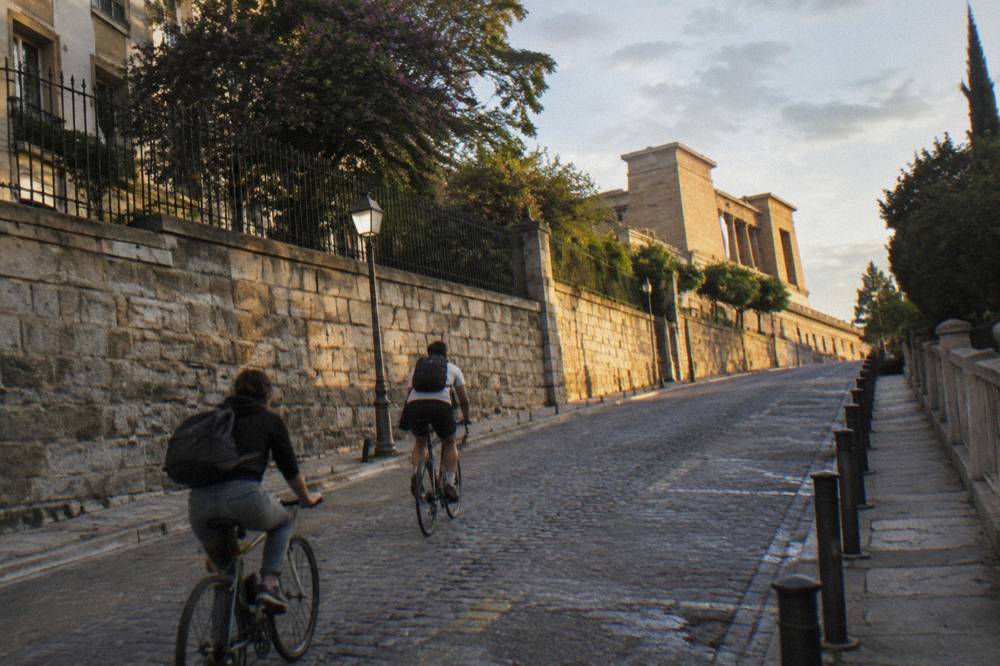
The e-bike alternative suits the uphill reality of the Debod approach. The Sunset and Night Lights E-Bike covers the same western viewpoints and then leans into the after-dark city, on pedal-assist bikes that flatten the climb back from the river. Its rating of 4.9 comes from a small pool of 17 reviews, so it reflects strong but limited feedback rather than a large review base. Both sunset tours meet on or near Calle de Santiago, a short walk from Sol, which makes them easy to slot into an evening without crossing the city.
Daytime visitors are not left out. The most reviewed ride in the city, the 3-Hour Highlights Bike Ride, rated 4.9 across 1,989 reviews and priced from $32.14 per person, sweeps the Royal Palace and Retiro with a group capped at 15 and bottled water included; the temple's neighbourhood sits at the western edge of that kind of centre loop, and a rider who falls for the area can come back for the sunset version on a later evening.
Want A Guide To Handle The Timing?
A sunset ride depends on the sky, and free cancellation on the booking page means a cloudy forecast does not lock you in. Check availability and read the cancellation terms before you commit to a date.
How Do You Get To The Temple Of Debod By Bike?
The temple sits at the top of the Parque de la Montaña, and the two natural cycling approaches are from the south along the Madrid Rio river path and then up through the Parque del Oeste, or from the east through the Royal Palace district; both finish with a short, walked final stretch because the terrace is a pedestrian zone. The city's own cycling rules put bikes on the carriageway, in the centre of the lane, with bike lanes optional unless a sign makes them mandatory, a rule set out in the Ayuntamiento's cycling FAQ. In practice the approach corridors here are calm park roads and riverside paths rather than busy arterials.
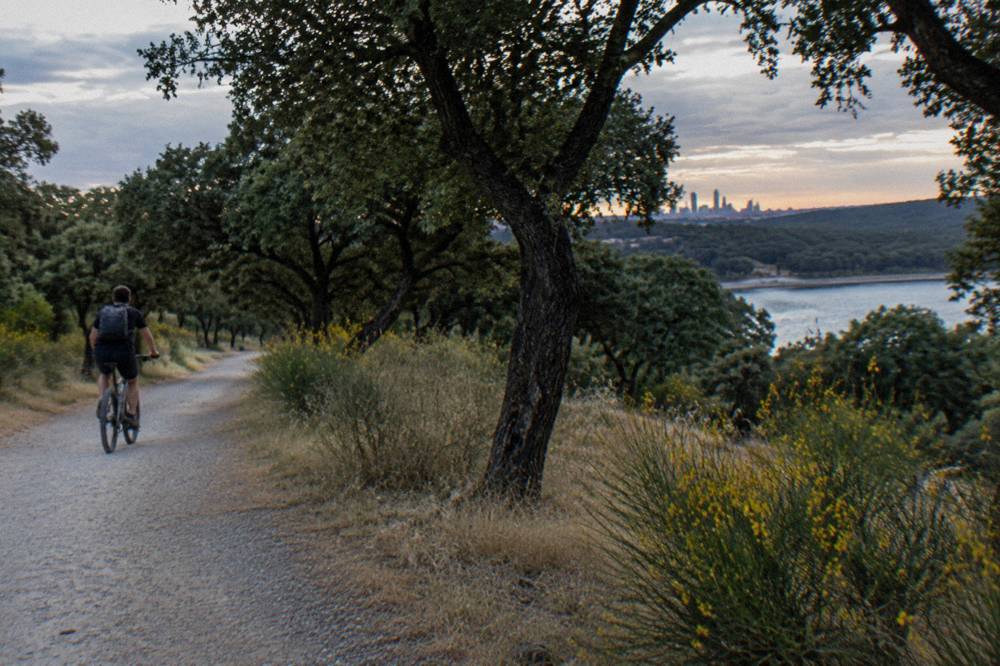
From the city centre, the simplest line is west from the Opera and Royal Palace area, past Plaza de Oriente, and up through the park; the climb is real but short. From the river, ride the Madrid Rio path north, exit toward the Principe Pio transport hub, and climb through the Parque del Oeste's tree-lined roads to the temple. Riders coming from Casa de Campo on the far bank should note the park's own rules, published by the city: a 20 km/h cap, paved roads and wide dirt paths only, and no cross-country trail riding, per the official Casa de Campo cycling guidance.
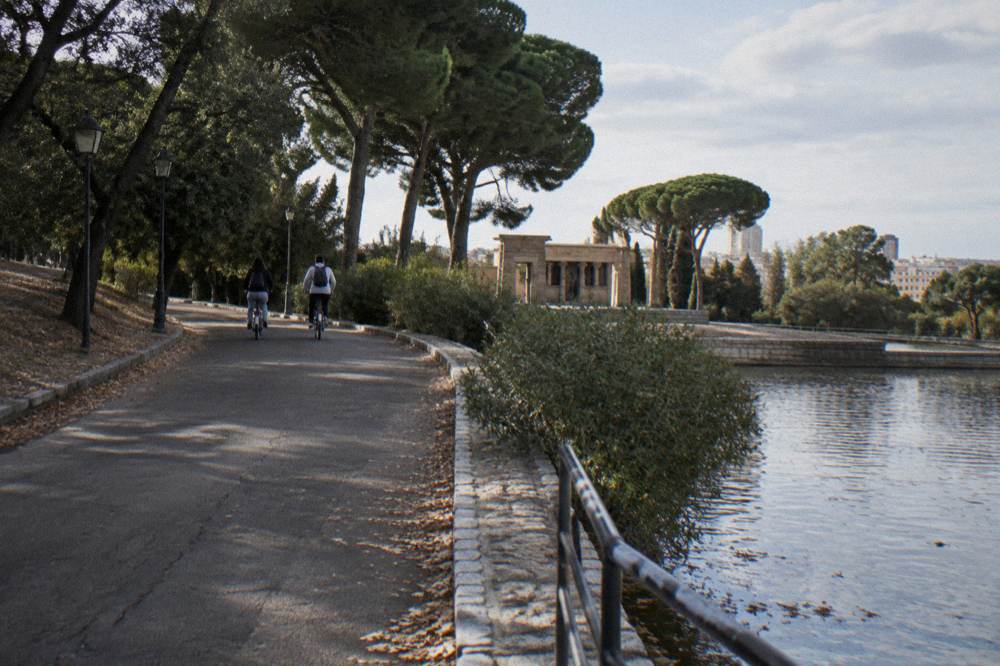
Surface quality varies. The river path is smooth and wide, the park roads are decent asphalt, but some of the older streets near the palace have cobbles that reward wider tyres and a slower line. E-bikes make the whole approach trivial, and several tours let each rider choose between a regular bike and an e-bike at booking, which is worth using if your evening includes the climb. A comparison of the two formats is laid out in the e-bike versus regular bike in Madrid guide.
If you are riding after dark, Madrid's rules require a front white light and a rear red light, plus a rear reflector at all times. That applies to the ride home from any sunset stop, and rental and tour bikes are normally set up for it, but it is worth checking the bike before you roll out. Riders who want the full context on local rules can read the cycling rules in Spain guide.
What Should You Know About Cycling In The Parks Around The Temple?
The green belt around the temple, the Parque del Oeste, the rose garden and the slopes down to the river, is one of the calmest cycling terrain in central Madrid, but park paths are shared with pedestrians, the city asks cyclists to ride slowly with pedestrian priority, and the busiest sunset hour is exactly when that matters most. Two conflicting figures circulate for park path speed caps, so this site prints neither as a hard limit; the honest instruction is slow, pedestrians first, and dismount where a crowd makes even slow riding awkward.
The terrain west of the temple rewards a loop rather than an out-and-back. A natural evening circuit runs temple, Parque del Oeste descent, river path, then back over the Principe Pio bridge and up the palace side, catching the palace and the Almudena lit up on the return. Riders with more appetite can cross into Casa de Campo on the far bank, keeping to its paved roads under its 20 km/h cap, though there is no BiciMAD docking station inside the park; the nearest one sits at Principe Pio.
| Approach corridor | Terrain | Character | Watch for |
|---|---|---|---|
| Madrid Rio river path | Wide, smooth, traffic-free | Fast and easy, great at dusk | Pedestrians at busy times |
| Parque del Oeste roads | Asphalt park roads, gentle climbs | Leafy and quiet | Narrow sections near the rose garden |
| Palace district streets | Cobbles and one-way streets | Scenic but bumpy | Crowds near Plaza de Oriente |
| Casa de Campo (across the river) | Paved roads and wide dirt paths | Open and rural feeling | 20 km/h cap, no trails, no docking station |
Helmets are worth a mention here because the rules are layered. In Madrid, the city rule makes helmets mandatory for riders under 18 and recommends them for everyone else, while a national reform that took effect on 1 October 2026 removed the helmet exemptions for cyclists on interurban roads, per the DGT announcement of the reform. None of that affects an urban park loop directly, but most of the tours covering this area include or offer helmets anyway, and the booking page for each ride shows which.
The E-Bike Panoramic Views and Parks ride is the park-focused option: a 3-hour e-bike tour capped at 14 riders, rated 4.9 across 30 reviews, from $41.33 per person, meeting on Calle de Felipe IV by Retiro. It leans into exactly the green-corridor riding this section describes, with helmet, guide and bottled water included, though entrance fees and tips are not.
How Does Madrid's Weather Affect A Sunset Ride?
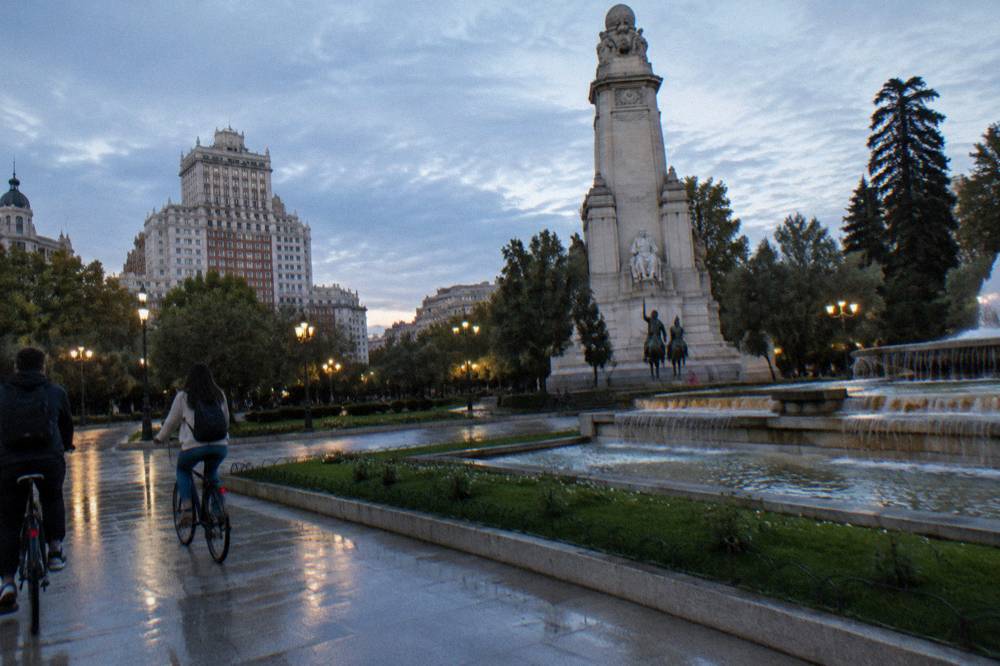
Madrid's evening weather swings hard across the year: July and August mean daily maxima averaging 32.1 °C and 31.3 °C with almost no rain, October and November are the wettest months at 60 and 58 mm, and winter evenings sit near a 6.3 °C January mean, so the same sunset stop demands suncream in July and gloves in January. Those figures come from AEMET's long-term climate normals recorded at the Retiro station, published by the national weather service, and they shape the whole planning question.
Summer deserves a specific warning, and the site covers it in depth in the cycling Madrid in summer heat guide. A July sunset arrives late in the evening after a full day of heat radiating off stone and asphalt, so the climb to the terrace can land harder than the distance suggests. Water, a slow pace, shade stops in the park and an e-bike are the standard answers. Several tours include bottled water in the ticket, which reads as a small thing until the third hill.
| Season | Evening feel (long-term averages) | Planning notes |
|---|---|---|
| Spring (Mar to May) | Mild, mean 11.2 to 16.7 °C | Good balance of light and comfort; May has the most thunderstorm days |
| Summer (Jun to Aug) | Hot, mean maxima 28.2 to 32.1 °C | Late sunsets, carry water, prefer an e-bike on climbs |
| Autumn (Sep to Nov) | Cooling, October wettest at 60 mm | Most dramatic skies, highest rain risk, bring a layer |
| Winter (Dec to Feb) | Cold, January mean 6.3 °C | Early sunsets, gloves and lights, thin crowds |
Rain strategy matters more than rain frequency. The city averages only about 59 rain days a year, so the odds are with you, but a wet evening ends the photograph. One tour operator in this area states plainly that its rides run rain or shine with a 2 euro poncho available, so read each booking page's weather policy rather than assuming; most of the sunset options list free cancellation, which is the practical escape hatch when the forecast turns.
What Should You Bring On An Evening Ride To The Temple?
Bring water, a light layer, front and rear lights for the ride home, comfortable shoes for a walked terrace stretch, and a phone or camera with charge to spare; in summer add suncream, and in winter add gloves, because the terrace is exposed and the wait before the light peaks can run an hour. Everything on that list fits in a small bag or a basket, and none of it is exotic, which is the point: the sunset itself is free and the preparation is modest.
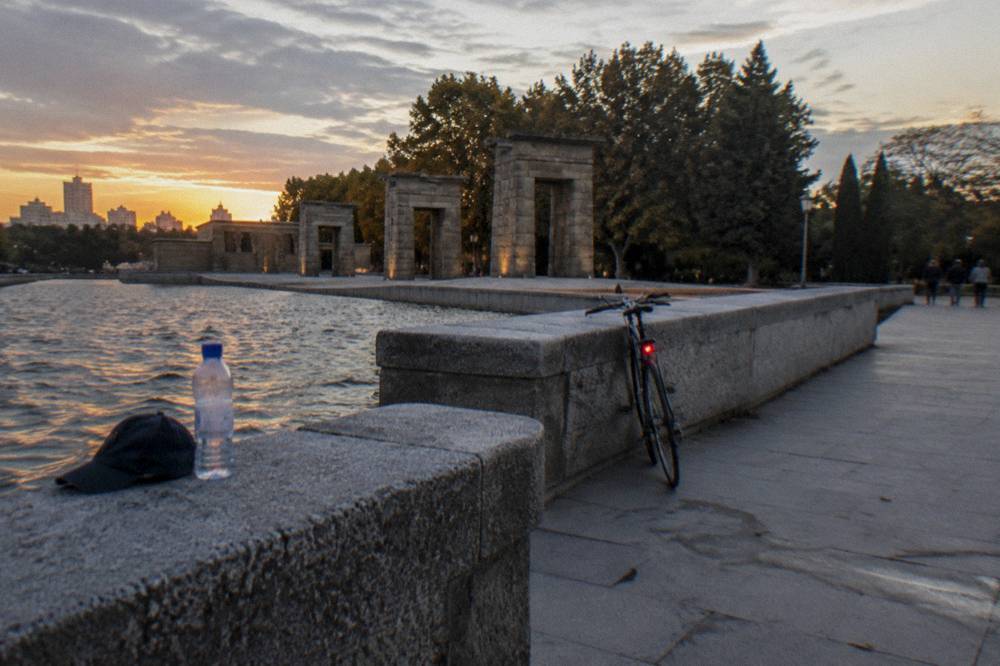
A short checklist keeps it honest. Bottled water comes included on several of the tours above, but independent riders should carry their own, especially from June to August. Lights are a legal requirement after dark, front white and rear red, and a rear reflector is required at all times in the city. A layer answers the temperature drop that follows sunset in every season except high summer. Shoes you can walk in matter because the terrace approach and the photo spots involve standing and strolling, not riding. A full packing breakdown, including what the tours already provide, sits in the what to bring on a Madrid bike tour guide.
| Item | Why it matters at Debod | Season |
|---|---|---|
| Water | The summer climb and the exposed terrace wait | All year, critical Jun to Aug |
| Front and rear lights | Legally required after dark on the ride home | All year |
| Light layer | Temperature drops quickly once the sun is gone | Spring, autumn, winter |
| Gloves and warm hat | January evening mean sits near 6.3 °C | Winter |
| Camera or charged phone | The whole point of the stop | All year |
One last practical note on food. The temple terrace is a picnic spot, not a restaurant row, and this site prints no cafe or bar recommendations. Several tours in the city offer an optional tapas add-on, and one 3-hour ride lists tapas as an option at booking; treat those as choices on the booking page rather than included meals. The only tour on the city's list with a full meal included is the 5-Hour Food E-Bike, a different product for a different evening.
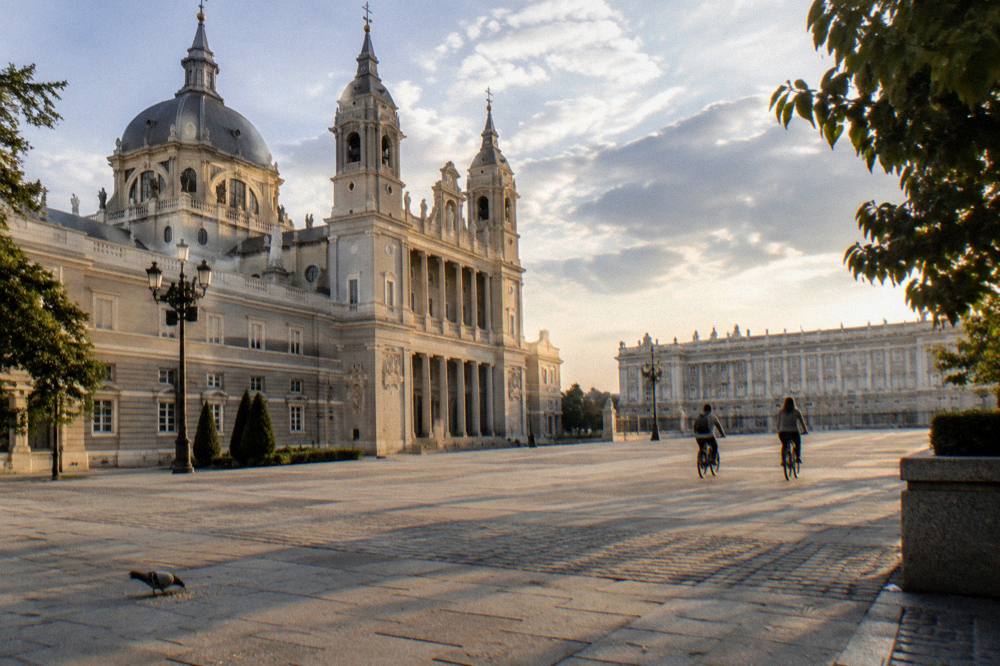
The Temple of Debod rewards exactly the kind of visitor who ends up on this site: someone happy to ride a quiet park road at golden hour rather than queue for a viewpoint bus. Whether you plan the loop yourself from the timing notes above or let a guide chase the light for you, the mechanics are simple, and the payoff, a silhouette far older than the city around it against a Spanish sky, is one of Madrid's genuine free wonders. These are the rides that fit the plan best.
Common Questions About The Temple Of Debod At Sunset
When Is The Best Time Of Day To Visit The Temple Of Debod?
The last 60 to 90 minutes before sunset, when the sky colours develop and the temple silhouettes against the western horizon. Exact sunset times shift week by week, so check a weather app for your date and arrive early for a spot on the terrace ledge.
Which Madrid Bike Tours Pass The Temple Of Debod?
The Sunset-Chasing Bike Ride, a 2-hour regular-bike tour from $40.18 per person, and the Sunset and Night Lights E-Bike, a 2-hour e-bike tour from $45.00 per person rated 4.9 across 17 reviews, both build their routes around evening viewpoints. The 3-Hour Highlights Bike Ride covers the west-side landmarks nearby during the day.
Can You Ride A Bike Up To The Temple Itself?
No, the terrace around the temple is a pedestrian zone, and city rules prohibit bikes on pavements and pedestrian streets except signed bike-pavements. Ride the park roads to the edge of the Parque de la Montaña, then walk the final stretch.
Is The Ride To The Temple Hard?
The approach climbs from both the centre and the river, but the distances are short. A regular bike at a relaxed pace handles it for most riders, and several tours let each rider choose an e-bike at booking, which flattens the climb in summer heat.
What Lights Does A Bike Need After Dark In Madrid?
A front white light and a rear red light at night, plus a rear reflector at all times. Those are city requirements for the ride home from any sunset stop, and they apply to rental and tour bikes as much as private ones.
Do The Sunset Tours Run If The Sky Is Cloudy?
Policies vary by operator; one states its rides run rain or shine with a poncho available for a small fee. Most sunset options list free cancellation, so check the booking page's weather and cancellation terms before committing to a date.